Thinking about visiting Kyoto without spending too much? You’re in the right place! Kyoto can be expensive, especially when it comes to accommodation during busy travel periods, but you don’t need a huge budget to experience the city.
From affordable accommodation and inexpensive local food to public transportation, free sights, and self-guided walks, there are plenty of ways to visit Kyoto on a budget.
Whether you’re a solo traveler, couple, family, or first-time visitor, these practical tips will help you save money while still enjoying Kyoto’s temples, historic neighborhoods, gardens, markets, food, and traditional culture. 🌏✨
Affiliate Disclosure: Some links on this page may be affiliate links. If you make a purchase through one of these links, I may earn a small commission at no extra cost to you.
💵 How Much Does a Trip to Kyoto Cost?
Your Kyoto travel budget will depend on your accommodation, food choices, transportation, activities, and travel dates.
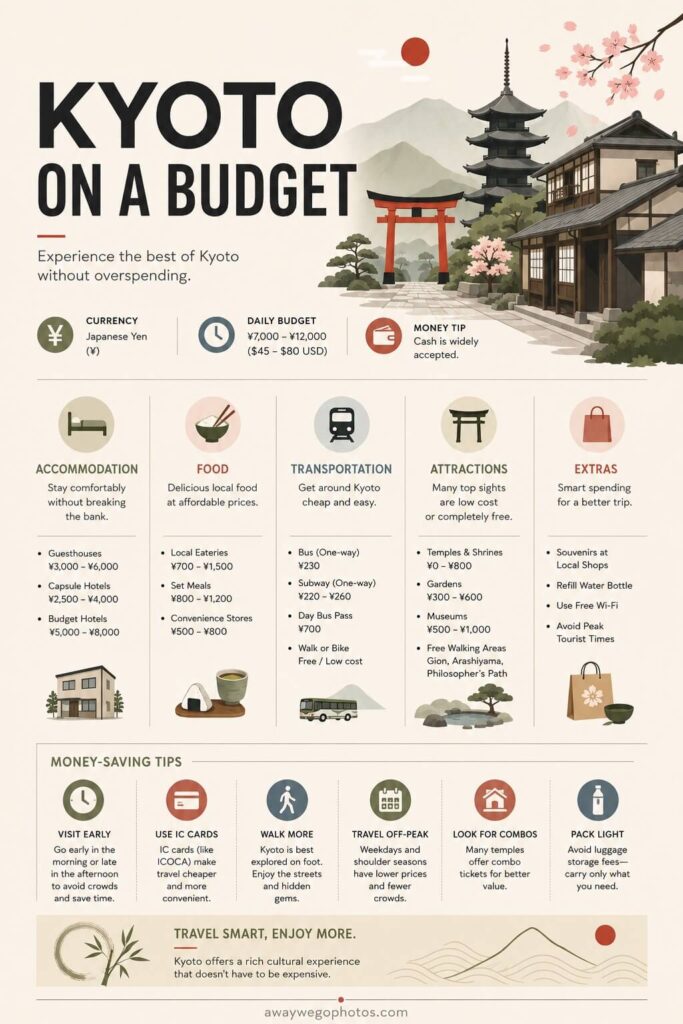
As a practical starting point, a budget traveler can aim for around $60–$100 per person per day, excluding international flights. Mid-range travelers may spend around $120–$220 per day, while travelers choosing nicer hotels, more restaurants, taxis, and paid experiences can easily spend $250+ per day.
| Travel Style | Approx. Daily Budget |
|---|---|
| 🎒 Budget Traveler | $60–$100 |
| 🙂 Mid-Range Traveler | $120–$220 |
| ✨ Comfortable Traveler | $250+ |
These are planning estimates rather than fixed prices. Kyoto accommodation prices can change considerably depending on the season and demand.
🎒 Budget Traveler
A budget traveler spending around $60–$100 per day could potentially cover:
- 🛏️ Budget accommodation or hostel
- 🍜 Affordable local meals
- 🚇 Public transportation
- 🏛️ Free and inexpensive attractions
- ☕ Snacks and drinks
- 🚶 Plenty of walking
One important extra cost to remember is Kyoto’s accommodation tax. Since March 1, 2026, the tax ranges from ¥200 to ¥10,000 per person per night, depending on the accommodation price. For accommodation costing under ¥6,000 per person per night, the tax is ¥200.
💡 Budget Tip: When planning your Kyoto budget, remember to include accommodation taxes, transportation, meals, attraction entrance fees, and small daily expenses. These extras can add up quickly during a longer trip.
🛏️ 1. Save Money on Accommodation
Accommodation can be one of the biggest expenses during a Kyoto trip.
To reduce your costs, consider:
- 🏨 Budget hotels
- 🛏️ Hostels
- 🏠 Guesthouses
- 📍 Staying outside the most expensive tourist areas
- 📅 Traveling during less expensive periods
- 📆 Booking early when possible
- 🛌 Choosing rooms with shared facilities
Kyoto’s hotel market can become particularly expensive during periods of strong demand, so comparing several dates can make a big difference.
💡 Budget Tip
Don’t automatically choose the cheapest room you can find.
Look at the total cost, including transportation and accommodation taxes. A slightly more expensive hotel near a train or subway station may save you money on transportation and time.
You can also consider areas around Kyoto Station, Gojo, Kujo, or other neighborhoods with convenient public transportation rather than paying a premium to stay directly beside the most famous sightseeing streets.
👉 Related Guide: Kyoto Travel Guide
🏯 Experience Kyoto's Highlights
Travel between Kyoto's iconic attractions on a full-day sightseeing bus tour featuring Fushimi Inari, Kinkakuji, and the scenic Bamboo Grove.
Book the Tour →🍜 2. Eat Like a Local
You don’t need expensive restaurants to enjoy great food in Kyoto.
Look for:
- 🍜 Ramen shops
- 🍱 Set-meal restaurants
- 🍛 Japanese curry restaurants
- 🍙 Convenience-store meals
- 🥢 Casual noodle restaurants
- 🛒 Supermarkets
- 🏪 Convenience stores
- 🥐 Bakeries
- 🍡 Traditional snacks
A reasonable budget traveler can often plan around $15–$30 per day for basic food if they mix inexpensive restaurants with supermarket or convenience-store purchases.
💰 Money-Saving Tip
Lunch is often a great opportunity to save.
Look for teishoku set meals, noodle shops, curry restaurants, and lunch specials rather than eating at expensive restaurants around major tourist attractions.
You can also visit supermarkets later in the day for discounted prepared foods.
👉 Related Guide: 10 Must-Try Foods in Kyoto
🚇 3. Use Public Transportation
Public transportation is one of the best ways to explore Kyoto without spending heavily on taxis.
Depending on your itinerary, you can use:
- 🚇 Kyoto Subway
- 🚌 Kyoto City Buses
- 🚆 JR trains
- 🚃 Private railway lines
- 🚶 Walking
Kyoto’s official tourism information recommends combining trains, buses, and walking depending on your destination. Major sights such as Fushimi Inari, Higashiyama, Arashiyama, and Kinkaku-ji can be reached using different combinations of rail and bus services.
The standard city-bus fare in the basic zone is currently ¥230 for adults.
Kyoto also offers a Subway & Bus 1-Day Pass for ¥1,100, which can be useful if you plan to make several qualifying journeys in one day.
📱 Transportation Tip
Don’t automatically buy a day pass.
Calculate roughly how many trips you will make. If you are visiting only two or three places, individual fares may be cheaper.
For sightseeing-heavy days, however, a pass can sometimes make transportation simpler and more economical.
👉 Related Guide: Kyoto Cheat Sheet
🏛️ 4. Take Advantage of Free Attractions
One of the easiest ways to save money in Kyoto is to build your itinerary around places that are free to visit.
Consider:
- ⛩️ Shrine grounds
- 🌳 Parks
- 🚶 Historic streets
- 🏘️ Traditional neighborhoods
- 🌅 Scenic viewpoints
- 🛍️ Shopping streets
- 🌿 Riverside walks
- 🎋 Bamboo-filled walking routes
- 🏯 Temple grounds that don’t require an entrance fee
Some of Kyoto’s most memorable experiences involve simply walking through historic neighborhoods and observing the architecture, gardens, shrines, shops, and traditional streets.
For example, exploring areas around Gion, Higashiyama, Fushimi, and Arashiyama can provide plenty to see without requiring an entrance ticket at every stop.
👉 Related Guide: 10 Best Things to Do in Kyoto
🎟️ 5. Look for Discounted Attractions
You don’t have to avoid paid attractions completely.
Before paying full price, check for:
- 🎫 Combination tickets
- 🎟️ Discount passes
- 🏛️ Special admission days
- 👨🎓 Student discounts
- 👨👩👧 Family discounts
- 📱 Online offers
- ⏰ Off-peak opportunities
- 🎟️ Advance-purchase discounts
💡 Budget Tip
Make a list of the attractions you most want to visit and calculate their individual entrance fees.
If you are considering a sightseeing pass, compare the total cost first. A pass is only a good deal if you actually use enough of its included attractions or transportation.
🚶 6. Explore Kyoto on Foot
Walking is completely free—and Kyoto is an excellent city for exploring on foot.
Instead of traveling directly from one attraction to another, group nearby sights together.
For example, you could spend part of a day walking through:
Kiyomizu-dera → Ninenzaka → Sannenzaka → Yasaka Shrine → Gion
This allows you to experience several historic areas without paying for multiple short transportation journeys.
Walking also gives you a chance to discover small streets, traditional buildings, local shops, gardens, and quiet corners that you might otherwise miss. 👟
👉 Related Guide: 1 Day in Kyoto
📅 7. Visit During a Cheaper Time of Year
When you visit Kyoto can have a major impact on your travel budget.
Accommodation prices can increase when demand is high, particularly during famous seasonal periods.
💰 Potentially More Affordable
- 🌱 Shoulder season
- 📅 Weekdays
- 🌧️ Less popular travel periods
- 🏨 Periods with lower hotel demand
- ✈️ Flexible travel dates
💸 Potentially More Expensive
- 🌸 Cherry blossom season
- 🍁 Peak autumn foliage
- 🎉 Major festivals
- 🎄 Holiday periods
- 📅 Popular weekends
- 🏨 Major events
Kyoto’s tourism market continues to experience substantial demand; for example, the Kyoto City Tourism Association reported a 78.9% hotel occupancy rate in June 2026 among its sample of major hotels and ryokan.
💡 Budget Tip
If your schedule is flexible, compare several weeks rather than choosing your dates immediately.
Even moving your trip by a few days can sometimes make accommodation considerably cheaper.
☕ 8. Save Money on Drinks and Snacks
Small purchases can quietly increase your travel budget.
Instead of buying drinks and snacks throughout the day:
- 💧 Carry a reusable water bottle
- 🛒 Buy snacks from supermarkets
- 🏪 Use convenience stores
- ☕ Choose affordable cafés
- 🍙 Buy inexpensive breakfast items
- 🍡 Pick up local snacks from supermarkets or casual shops
- 🥤 Avoid overpriced drinks around major attractions
Saving just a few dollars several times each day can make a noticeable difference over a week.
🚕 9. Avoid Unnecessary Transportation Costs
Taxis are convenient, but they can quickly increase your Kyoto travel expenses.
Before taking a taxi, ask:
- 🚇 Is there a train or subway?
- 🚌 Is there a bus?
- 🚶 Can I walk?
- 📍 Is another attraction nearby?
- 🚆 Can I combine this stop with another destination?
Kyoto’s transportation network allows you to combine different rail and bus services, so you don’t always need to rely on taxis.
💡 Budget Tip
Use taxis strategically rather than completely avoiding them.
If you’re traveling with several people, carrying luggage, or saving a significant amount of time, a taxi may sometimes be worthwhile. Otherwise, trains, buses, and walking are usually better choices for a budget-focused itinerary.
🛍️ 10. Be Smart About Shopping
Kyoto has plenty of beautiful souvenirs, from traditional crafts to sweets and local products.
But souvenir shopping can quickly become an unexpected expense.
For cheaper souvenirs, consider:
- 🎁 Local markets
- 🛍️ Discount stores
- 🏪 Supermarkets
- 🍵 Local tea
- 🍫 Japanese snacks
- 🍡 Traditional sweets
- 🎨 Small handmade items
- 🧸 Small local shops
💰 Budget Tip
Set a souvenir budget before your trip.
For example, decide that you will spend $30, $50, or $100 on souvenirs and gifts. This makes it easier to enjoy shopping without losing track of your spending.
💳 11. Watch Your Daily Spending
A simple daily budget can prevent small expenses from becoming a large bill.
Set spending limits for:
- 🛏️ Accommodation
- 🍜 Food
- 🚇 Transportation
- 🏛️ Attractions
- ☕ Snacks and drinks
- 🛍️ Shopping
- 💰 Miscellaneous expenses
Keep track of your spending using your phone’s notes app, spreadsheet, or budgeting app.
💡 Simple Rule
At the beginning of each day, decide:
“How much can I spend today?”
Then leave some room for unexpected expenses.
🚌 Book a Kyoto Bus Tour
Explore Kyoto’s famous sights at your own pace with a convenient hop-on hop-off sightseeing bus ticket.
Book the Tour →📊 12. Sample Kyoto Budget
Here is an example of what a budget travel day in Kyoto could look like:
| Expense | Estimated Budget |
|---|---|
| 🛏️ Accommodation | $30–$50 |
| 🍜 Food | $15–$30 |
| 🚇 Transportation | $5–$10 |
| 🏛️ Attractions | $0–$15 |
| ☕ Snacks & Drinks | $5–$10 |
| 🛍️ Miscellaneous | $5–$15 |
| 💰 Estimated Total | $60–$100+ |
These figures are planning estimates rather than fixed prices. Your actual spending can be higher or lower depending on your accommodation, travel dates, food choices, activities, and exchange rate.
Remember to factor Kyoto's accommodation tax into your hotel budget. From March 1, 2026, the tax is based on the accommodation price per person per night and ranges from ¥200 to ¥10,000.
💡 13. Easy Ways to Save Money in Kyoto
Here are some of the easiest ways to reduce your Kyoto travel costs:
- 💰 Stay in budget accommodation
- 🍜 Eat at local restaurants
- 🛒 Shop at supermarkets
- 🏪 Use convenience stores for inexpensive snacks
- 🚇 Use trains and buses
- 🚶 Walk whenever possible
- 🏛️ Visit free attractions
- 🎟️ Compare attraction prices
- 📅 Travel during less expensive periods
- ☕ Limit expensive café stops
- 🚕 Avoid unnecessary taxis
- 🛍️ Set a souvenir budget
- 💳 Track your daily spending
- 🎫 Compare transportation passes with individual fares
The biggest savings usually come from accommodation, transportation, and food, so focus your planning there first.
🧳 Is Kyoto Expensive to Visit?
Kyoto can be moderately expensive, but you don’t need a huge budget to enjoy it.
The biggest challenge is often accommodation during popular travel periods. However, once you’re in the city, you can keep costs under control by using public transportation, walking between nearby attractions, eating at casual restaurants, and mixing paid attractions with free experiences.
Kyoto also gives budget travelers plenty of opportunities to enjoy its culture without spending much.
You can walk through historic neighborhoods, visit shrines, explore traditional streets, enjoy public spaces, browse markets, and experience the atmosphere of areas such as Gion and Higashiyama.
The key is to decide what matters most to you.
Save on the things that don’t matter as much and spend your money on the experiences you really want.
📌 Kyoto on a Budget at a Glance
- 💰 Budget: Around $60–$100 per day
- 🛏️ Budget Accommodation: Around $30–$50 per night
- 🍜 Budget Food: Around $15–$30 per day
- 🚇 Transportation: Around $5–$10 per day
- 🏛️ Free Attractions: Shrines, historic streets, neighborhoods, parks, and scenic walks
- 📅 Best Time to Save: Flexible weekdays and less-demanded travel periods
- 💳 Main Money Tip: Walk between nearby attractions and use public transportation instead of taxis
🌏 Final Thoughts
Visiting Kyoto on a budget doesn’t mean missing out on the city’s best experiences.
With a little planning, you can enjoy traditional neighborhoods, beautiful temples and shrines, local food, historic streets, gardens, markets, and Japanese culture without constantly worrying about money. 💰✨
The best strategy is simple:
Save on the things that don’t matter as much and spend on the experiences you really want.
Whether you’re staying for one day or several days, a thoughtful itinerary can help you experience much of Kyoto without spending a fortune.
Have a wonderful trip to Kyoto! ✈️🇯🇵