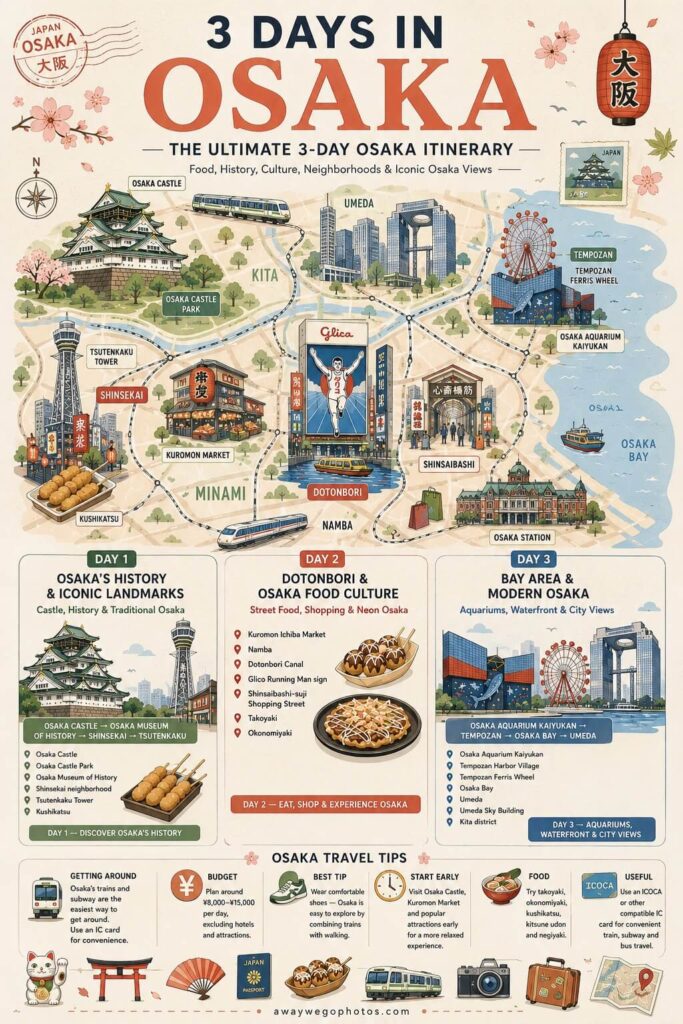
Osaka is one of Japan’s best cities for combining history, culture, food, architecture, and lively neighborhoods in a relatively compact area. While Tokyo can feel enormous, Osaka is easier to explore in focused districts, making 3 days in Osaka a good amount of time for a first visit.
This itinerary combines Osaka Castle and the city’s samurai-era history with ancient temples, traditional performing arts, historic markets, famous food, and modern city views. It also leaves enough time to wander rather than rushing from attraction to attraction.
The route is organized geographically to reduce unnecessary backtracking, with Osaka Metro and walking doing most of the work.
🗺️ 3 Days in Osaka at a Glance
📍 Day 1 — Osaka’s History & Castle
Osaka Castle → Osaka Museum of History → Nakanoshima → Umeda
📍 Day 2 — Traditional Osaka & Food Culture
Shitennoji → Shinsekai → Kuromon Market → Dotonbori → Namba
📍 Day 3 — Neighborhoods, Culture & Modern Osaka
Osaka Museum of Housing and Living → Tenjinbashisuji → Kitahama/Semba → Umeda Sky Building
Affiliate Disclosure: This post contains affiliate links. I may earn a small commission if you book through them, at no extra cost to you.
🏯 Discover Osaka's Top Sights
See the highlights of Osaka while walking through the city with a native local expert who can share insights you may miss on your own.
View the Tour →📍 Day 1 — Osaka Castle, History & Modern Umeda
The first day introduces the historical importance of Osaka before finishing in the city’s modern northern district.
🏯 Morning — Osaka Castle
Start early at Osaka Castle, one of the city’s defining landmarks.
The castle’s story is closely connected with Toyotomi Hideyoshi, who began construction of the original castle in the late 16th century. The site later became important under the Tokugawa shogunate after the fall of the Toyotomi regime.
The tower standing today is not the original structure. The current main tower was constructed in 1931 after citizens supported its reconstruction, and it underwent major renovations in the 1990s. Today, the museum inside the tower focuses heavily on Hideyoshi and the history of Osaka Castle.
Allow about 2–2.5 hours for the castle tower and surrounding park.
What to see:
- Osaka Castle Museum
- Castle walls and moats
- Osaka Castle Park
- Golden architectural details
- Views from the observation deck
The current museum is open 9:00 AM–6:00 PM, with last admission 30 minutes before closing; admission information can change, so check the official site before visiting.
🚶 Next: Walk or take the Osaka Metro toward Tanimachi 4-chome.
🏛️ Late Morning — Osaka Museum of History
Continue to the Osaka Museum of History, which is particularly useful for understanding the city beyond the castle.
The museum presents almost 1,400 years of Osaka’s history, including the ancient Naniwa Palace, medieval Osaka, the city’s development as a commercial center, and later urban history. Exhibits use full-scale and miniature reconstructions, documents, and visual displays.
Allow around 1.5 hours.
The museum currently operates from 9:30 AM to 5:00 PM and is generally closed on Tuesdays, with a different arrangement when Tuesday is a national holiday.
⭐ Why visit: Osaka is often associated with food and entertainment, but this museum makes it much easier to understand why the city became such an important political and commercial center.
🍜 Lunch — Osaka-Style Comfort Food
For lunch, try one of Osaka’s classic dishes rather than eating at a generic chain.
Good choices include:
- Okonomiyaki — savory cabbage-based pancakes cooked on a hot plate
- Takoyaki — round batter snacks filled with octopus
- Kitsune udon — soft udon with sweet fried tofu
- Osaka-style sushi — pressed or box sushi
Okonomiyaki and takoyaki are particularly associated with Osaka’s casual food culture.
🏙️ Afternoon — Nakanoshima & Central Osaka
After lunch, head toward Nakanoshima, the island between the Dojima and Tosabori rivers.
This is a good change of pace after the castle and museum. Instead of adding another major museum, spend time walking through the area’s historic architecture, riverside spaces, and former commercial district.
Continue toward Kitahama and Semba, areas that reflect Osaka’s history as a major merchant city.
Osaka’s official tourism guide highlights the Kitahama, Yodoyabashi, and Semba area for its historic commercial buildings and architecture.
Allow 1.5–2 hours, depending on how much walking and photography you enjoy.
🌆 Evening — Umeda
Finish Day 1 in Umeda, Osaka’s major northern transportation and commercial district.
Explore around Osaka Station before heading to the Umeda Sky Building.
The Kuchu Teien Observatory sits 173 meters above the city and provides a 360-degree view from its rooftop. The building itself is also an interesting example of modern Osaka architecture.
The observatory currently operates 9:30 AM–10:30 PM, with last admission at 10:00 PM. The current adult admission is ¥2,000.
📸 Best time: Late afternoon into sunset gives you the opportunity to see Osaka in daylight and after the city lights come on.
🍜 Day 1 Food
Keep Day 1 centered on Osaka classics.
Lunch: Okonomiyaki or kitsune udon
Afternoon snack: Takoyaki
Dinner: Osaka-style sushi, kushikatsu, or another local Japanese meal
Osaka’s food culture developed partly from its historic role as a commercial and distribution center. The city’s relationship with merchants, markets, seafood, and dashi helped shape the cuisine travelers experience today.
Related: 10 Must-Try Foods in Osaka
📍 Day 2 — Ancient Temples, Markets & Namba
Day 2 moves south and focuses on traditional Osaka, food culture, historic neighborhoods, and the energetic Minami area.
🛕 Morning — Shitennoji Temple
Begin at Shitennoji, one of Osaka’s most historically significant religious sites.
Founded by Prince Shotoku in 593, Shitennoji is regarded as Japan’s first state-sponsored Buddhist temple. Its distinctive layout reflects an ancient temple architectural tradition, while the complex has survived repeated disasters and wars over the centuries.
Spend around 1.5–2 hours exploring:
- Central temple complex
- Five-story pagoda
- Temple gates
- Garden
- Treasure Museum, if open
- Architectural layout
The temple’s main area currently operates from 8:30 AM to 4:30 PM from April through September, and until 4:00 PM from October through March.
🚶 Late Morning — Tennoji to Shinsekai
From Shitennoji, walk toward Shinsekai.
The neighborhood has a very different atmosphere from the polished commercial districts around Osaka Station. Its retro streets and Tsutenkaku Tower reflect a different chapter of Osaka’s urban history.
Take time to wander rather than simply photographing the tower.
🍢 Lunch — Kushikatsu
Shinsekai is a natural place to try kushikatsu, one of Osaka’s famous local foods.
Kushikatsu consists of skewered meat and vegetables coated in batter and breadcrumbs and deep-fried. The dish is particularly associated with the Shinsekai area and its casual food culture.
For travelers who do not want fried food, choose udon, sushi, or another local specialty instead.
🛍️ Afternoon — Kuromon Market
Take the Osaka Metro or walk toward Nipponbashi and visit Kuromon Market.
Known as “Osaka’s Kitchen,” Kuromon Market has approximately 150 shops spread along a covered shopping street of roughly 580 meters. Its history goes back to the late Edo period, when merchants traded seafood and other products around Enmyoji Temple.
Today you can find:
- Fresh seafood
- Sushi
- Fruit
- Meat
- Pickles
- Prepared foods
- Snacks
- Traditional ingredients
Allow 1–2 hours.
One important point: opening hours vary by individual shop, so don’t plan your entire day around a specific stall.
🎭 Optional Cultural Stop — National Bunraku Theatre
If traditional Japanese culture interests you, consider visiting the National Bunraku Theatre, only about a minute from Nippombashi Station.
Bunraku is Osaka’s traditional puppet theater and one of Japan’s major performing arts. The theater also has exhibition space introducing puppets and instruments. Performance schedules vary, so check the current calendar before building this into your itinerary.
For example, the 2026 Autumn Bunraku performances are scheduled for October 31–November 23, 2026, with multiple performances during the day.
If there is no performance during your visit, simply continue toward Dotonbori.
🌆 Evening — Dotonbori & Namba
End the day around Dotonbori and Namba.
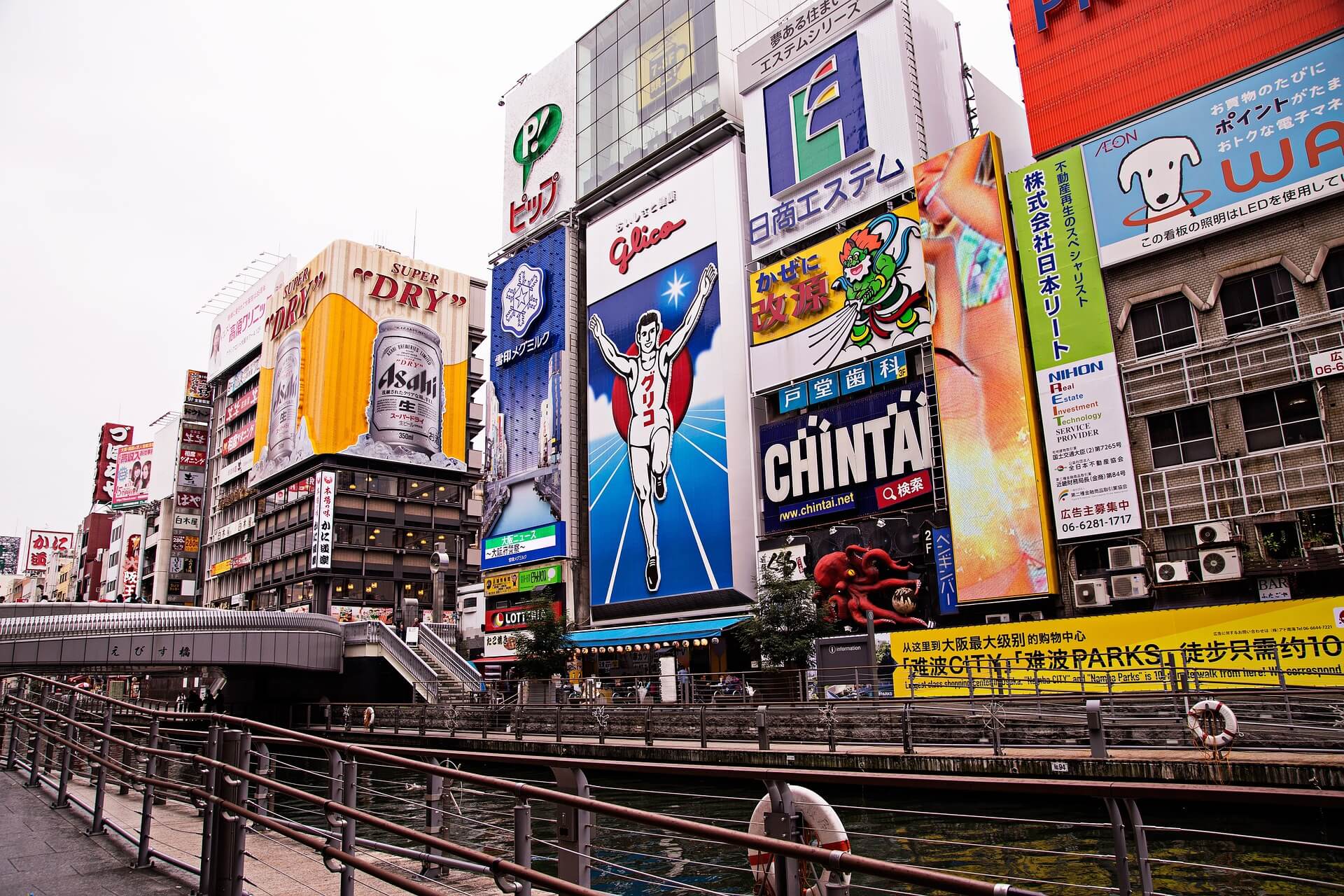
Dotonbori is one of Osaka’s most recognizable urban landscapes, with bright signs, restaurants, bridges, and the canal running through the district.
Walk along the canal, cross Ebisu Bridge, and explore the surrounding streets.
This is a good time to sample smaller portions of different foods rather than having one large meal.
Try:
- Takoyaki
- Okonomiyaki
- Osaka-style udon
- Sushi
- Local sweets
Takoyaki became popular in Osaka in the 1950s and evolved from earlier flour-based snacks.
📸 Photography tip: Dotonbori is especially atmospheric after dark, but expect crowds.
🎟️ Take a Kyoto & Nara Day Trip
See some of the region's best-known attractions on a guided bus tour covering Nara, Fushimi Inari Taisha, and Arashiyama.
Explore the Tour →📍 Day 3 — Local Osaka, Markets & Modern Architecture
The final day moves north again and focuses on everyday Osaka, architecture, traditional neighborhoods, and a relaxed final evening.
🏘️ Morning — Osaka Museum of Housing and Living
Start at the Osaka Museum of Housing and Living, where you can explore reconstructed streetscapes and learn about everyday life in Osaka during earlier periods.
This is a useful complement to the larger historical museums because it focuses less on political history and more on how the city was lived in.
Allow approximately 1.5 hours.
🚶 Tenjinbashisuji Shopping Street
After the museum, walk along Tenjinbashisuji, one of Osaka’s best-known long shopping streets.
Instead of treating it simply as a shopping destination, use the area as an opportunity to observe everyday urban life: small restaurants, local shops, traditional businesses, and neighborhood streets.
Stop for a light lunch or snack along the way.
🍜 Day 3 Food Experience
Make today your chance to try something different from the obvious Osaka staples.
Consider:
- Osaka-style sushi
- Udon
- Curry rice
- Japanese sweets
- Seasonal wagashi
- A traditional set meal
Osaka’s culinary identity extends well beyond takoyaki and okonomiyaki. Local specialties also include udon, pressed sushi, kushikatsu, and other dishes shaped by the city’s long food culture.
🏛️ Afternoon — Kitahama & Semba Architecture
Continue toward Kitahama and Semba, another area worth exploring on foot.
This part of central Osaka helps reveal the city’s identity as a merchant and business center. Look for older commercial buildings alongside modern offices and public spaces.
Rather than filling the afternoon with several ticketed attractions, allow 2–3 hours for walking, photography, coffee or tea, and exploring side streets.
This slower pace is intentional: after two busy days, Day 3 should feel less like a checklist.
🌇 Evening — Return to Umeda or Namba
For your final evening, choose the area you enjoyed most.
For city views: Return to Umeda.
For food: Return to Namba/Dotonbori.
For a quieter atmosphere: Spend time along the riverside or in one of Osaka’s central neighborhoods.
A three-day Osaka itinerary works best when the final evening is flexible rather than overloaded with another major attraction.
🚇 Getting Around Osaka
Osaka is particularly convenient for travelers who combine walking with the subway and rail network.
For this itinerary, Osaka Metro will be especially useful for moving between major districts.
An IC card is convenient for regular public transportation, while Osaka Metro also offers the Enjoy Eco Card, a one-day pass covering Osaka Metro and eligible Osaka City Bus services. The current adult price is ¥820 on regular weekdays and ¥620 on Saturdays, Sundays, and holidays.
However, don’t automatically buy a day pass. Compare the expected fares for your specific day because walking between nearby attractions can reduce the number of rides.
Best strategy:
- Walk within individual neighborhoods.
- Use Osaka Metro for longer jumps.
- Use JR or private railways when they provide a more direct route.
- Allow extra time for navigating large stations.
- Avoid crossing the city repeatedly.
🏨 Where to Stay in Osaka
For this three-day itinerary, staying somewhere central can save considerable transportation time.
Namba
Best for: Food, first-time visitors, convenience
Namba places you close to Dotonbori, Kuromon Market, Shinsaibashi, and many southern Osaka attractions.
Umeda
Best for: Transportation, shopping, modern Osaka
Umeda is ideal if you plan to explore Osaka’s northern districts or make day trips by train.
Tennoji
Best for: History, temples, and good value
Tennoji provides convenient access to Shitennoji, Shinsekai, and southern Osaka while remaining well connected.
Honmachi / Yodoyabashi
Best for: A quieter central location
These areas are useful for travelers who want central transportation and easier access to Osaka’s historic commercial districts without staying directly in the busiest tourist areas.
🌤️ Best Time to Visit Osaka
🌸 Spring
Spring brings comfortable sightseeing weather and cherry blossoms, but popular parks and attractions can become extremely crowded during peak bloom.
☀️ Summer
Summer is hot and humid, with occasional heavy rain. Plan outdoor sightseeing for mornings and use museums during the hottest part of the afternoon.
🍁 Fall
Fall is one of the most comfortable periods for walking around Osaka. Cooler temperatures and autumn foliage make temple grounds and parks particularly enjoyable.
❄️ Winter
Winter is generally cooler and less humid. December can be busy around holiday events, while January and February can provide a quieter sightseeing experience.
For any season, check individual attraction schedules before traveling because opening hours, temporary closures, and special exhibitions can change.
💰 Estimated Osaka Budget
Your daily spending will depend heavily on accommodation and dining choices, but a reasonable sightseeing budget can be planned around the following ranges:
- Local transportation: roughly ¥1,000–¥2,000 per day depending on your route
- Major attractions: often several hundred to around ¥2,000 per attraction
- Casual lunch: approximately ¥800–¥1,500
- Casual dinner: approximately ¥1,500–¥3,000+
- Snacks: often a few hundred yen each
- Mid-range daily sightseeing and food: approximately ¥4,000–¥8,000 excluding accommodation
These are planning estimates rather than fixed prices. Attraction admission, food, and transportation costs can change, so check official websites shortly before your trip.
💡 8 Practical Tips for 3 Days in Osaka
- Start major attractions early. Osaka Castle and popular markets become much busier later in the day.
- Group attractions by neighborhood. This itinerary deliberately keeps each day geographically focused.
- Don’t underestimate station walking time. Major Osaka stations can be large and confusing when you’re unfamiliar with them.
- Carry an IC card. It makes routine train and subway journeys much easier.
- Check museum closing days. Some museums close on Tuesdays or other scheduled days. The Osaka Museum of History, for example, normally closes Tuesdays.
- Treat Kuromon Market as a flexible food stop. Individual stores have different opening hours.
- Reserve cultural performances early. If you want to see Bunraku, check the performance calendar before your trip because performances are seasonal.
- Leave room for wandering. Some of Osaka’s best experiences come from exploring shopping streets, side streets, small restaurants, and neighborhood architecture rather than constantly checking attractions off a list.
❓ FAQ: 3 Days in Osaka
Is 3 days enough for Osaka?
Yes. 3 days in Osaka is a good amount of time for a first visit. It allows you to see major attractions such as Osaka Castle while also exploring Shitennoji, Kuromon Market, Dotonbori, Shinsekai, Umeda, and several historic neighborhoods.
What should I not miss in Osaka in 3 days?
For a first visit, prioritize Osaka Castle, Osaka Museum of History, Shitennoji, Kuromon Market, Dotonbori, and Umeda. These provide a good mix of history, culture, food, neighborhoods, and modern city scenery.
Is Osaka Castle worth visiting?
Yes, particularly if you are interested in Japanese history. The present tower is a 20th-century reconstruction, but the site is deeply connected with Toyotomi Hideyoshi and the political history of Osaka.
What food should I try in Osaka?
Start with takoyaki and okonomiyaki, then try kushikatsu, udon, Osaka-style sushi, and other local dishes. Osaka’s food culture is much broader than its two most famous specialties.
Should I stay in Namba or Umeda?
Choose Namba if food, Dotonbori, Kuromon Market, and southern Osaka are your priorities. Choose Umeda if transportation, northern Osaka, and modern city attractions are more important.
Do I need an Osaka subway pass?
Not necessarily. An IC card is often the simplest option. The Enjoy Eco Card can be worthwhile on days with several Osaka Metro and eligible city-bus journeys, so compare the pass price with your planned routes.
📌 Final Thoughts
Three days gives you enough time to experience Osaka without turning the trip into a race between attractions. Start with the city’s history around Osaka Castle, explore ancient Shitennoji and the traditional southern neighborhoods, then slow down on the final day with local shopping streets, architecture, museums, and food.
The biggest advantage of this 3 Days in Osaka itinerary is its balance. You get the major Osaka attractions, but you also have time to understand the city through its markets, temples, merchant districts, food culture, and everyday neighborhoods. Use the schedule as a framework rather than a strict checklist, and leave room to discover the parts of Osaka that interest you most.