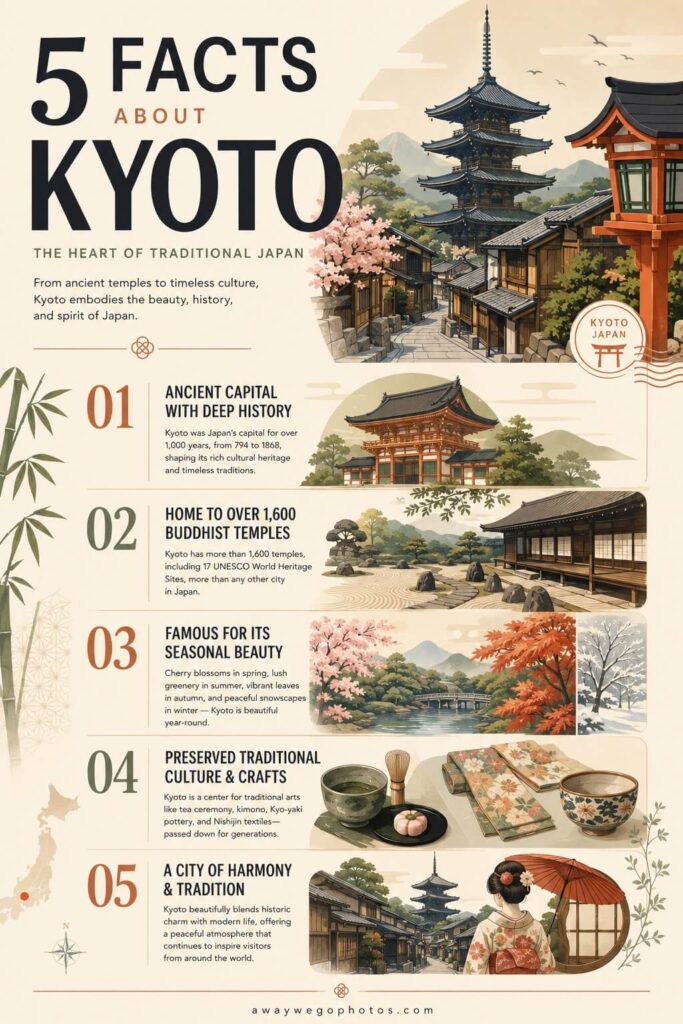
Planning a trip to Kyoto or simply curious to learn more about this fascinating destination? Kyoto is one of Japan’s most historically and culturally significant cities, with more than a thousand years of history shaping its temples, gardens, traditions, neighborhoods, and food.
From its long history as Japan’s imperial capital to its remarkable collection of temples, shrines, gardens, and traditional arts, these 5 facts about Kyoto offer a quick introduction to what makes the city so special.
Whether you’re planning your first visit or simply want to understand Kyoto better, these facts will give you a deeper appreciation of Japan’s ancient cultural heart.
Affiliate Disclosure: Some links on this page may be affiliate links. If you make a purchase through one of these links, I may earn a small commission at no extra cost to you.
1. 🏯 Kyoto Was Japan’s Capital for More Than 1,000 Years
Kyoto’s history as an imperial capital began in 794, when Emperor Kanmu established Heian-kyo, the new capital of Japan.
The city was carefully planned and modeled partly on the grid layout of Chang’an, the capital of Tang-dynasty China. Its streets were arranged in a highly organized pattern, with major roads running north to south and east to west. Elements of this original urban design can still be seen in Kyoto’s street layout today.
Kyoto remained the center of Japan’s imperial court and political life for more than a millennium. Although the emperor’s political role changed considerably over the centuries, the city remained an important center of Japanese culture, religion, literature, and the arts.
The imperial capital was eventually moved to Tokyo in 1869, bringing Kyoto’s official period as Japan’s capital to an end.
Travel connection: Visit the Kyoto Imperial Palace and surrounding historic areas to learn more about the city’s centuries as the home of Japan’s imperial court. Exploring neighborhoods such as Gion and Higashiyama also gives you a sense of Kyoto’s historic character.
🌸 A Day of Kyoto Highlights
Discover some of Kyoto’s most beautiful places in one day, including Fushimi Inari, Kinkakuji, and Arashiyama’s Bamboo Grove.
Book Your Tour →2. 🍵 Kyoto Is a Center of Living Japanese Traditions
Kyoto is famous not only for preserving traditional culture but also for keeping many of those traditions alive today.
For centuries, Kyoto developed as a center for Japanese arts, craftsmanship, religion, and court culture. Traditional practices associated with the city include tea culture, flower arrangement, Noh theater, kimono production, ceramics, calligraphy, and traditional dance. Kyoto’s official tourism guide describes this heritage as a living culture that has been passed down for more than a thousand years.
One of the fascinating things about Kyoto is that these traditions are not limited to museums. Visitors may encounter traditional crafts in workshops, seasonal festivals in neighborhoods, beautifully prepared tea experiences, and traditional performances.
The city’s cultural identity has also evolved over time. Rather than simply preserving the past, Kyoto continues to develop new ideas and practices from its historical foundations.
Travel connection: Visit Gion and Higashiyama, explore traditional craft shops, attend a cultural performance, or experience a Japanese tea ceremony. These experiences can help you see how Kyoto’s traditional culture continues in everyday life.
3. ⛩️ Kyoto Has an Extraordinary Collection of Historic Temples, Shrines, and Gardens
Kyoto is home to an extraordinary concentration of historic religious architecture and traditional Japanese gardens.
The city has more than a thousand temples and shrines, and many of its historic sites are closely connected with the development of Japanese architecture, religious traditions, and garden design.
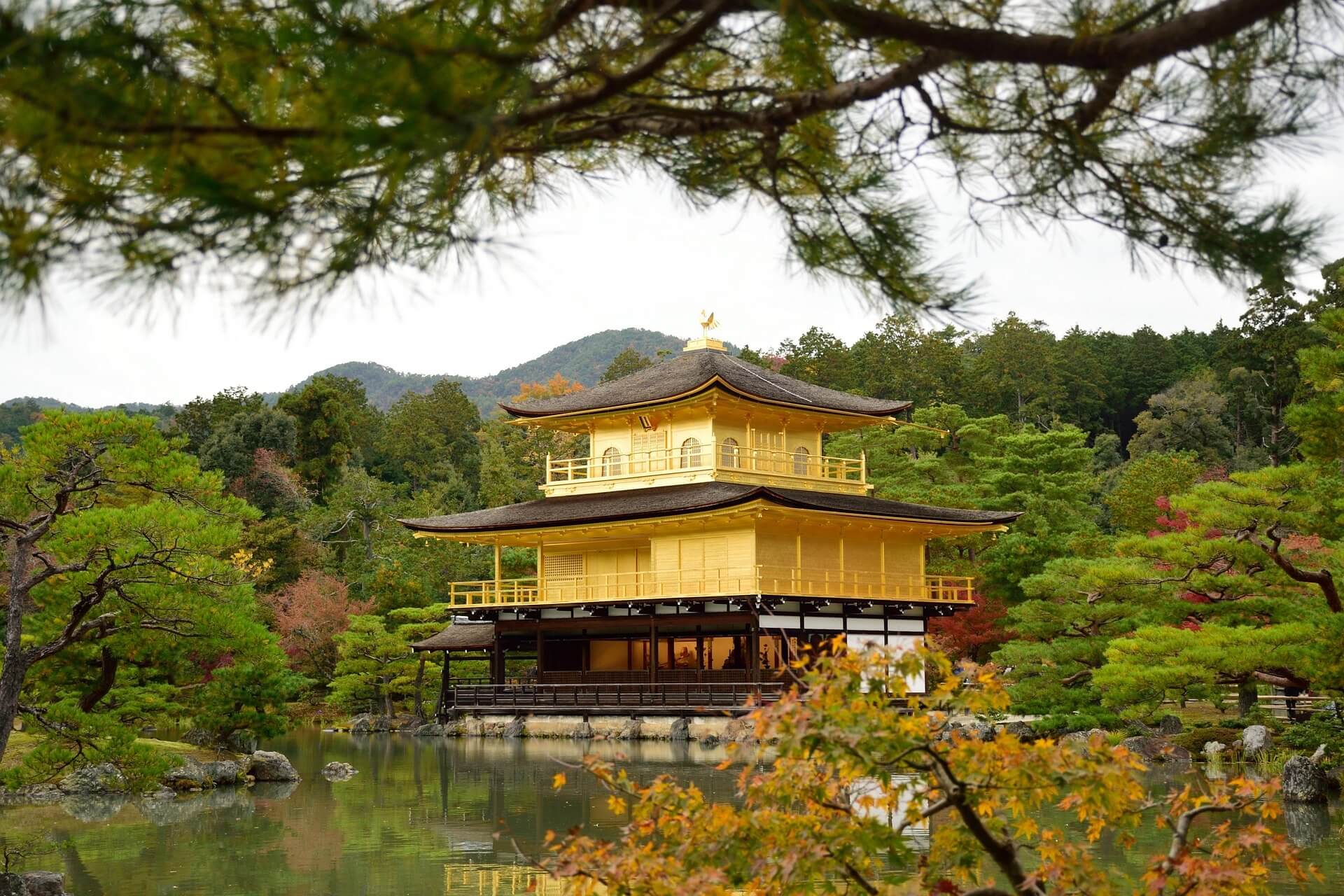
Kyoto’s UNESCO-listed heritage is particularly remarkable. The Historic Monuments of Ancient Kyoto World Heritage property includes 17 component sites across Kyoto, Uji, and Otsu. These include famous places such as Kiyomizu-dera, Kinkaku-ji, Ryoan-ji, Ninna-ji, and Nijo-jo Castle. The property was inscribed on the UNESCO World Heritage List in 1994.
These sites demonstrate how Japanese wooden architecture and garden design developed over centuries. Some gardens are carefully designed landscapes featuring ponds, rocks, moss, and trees, while others use simplicity and empty space to create a sense of calm.
Travel connection: Add Kiyomizu-dera, Kinkaku-ji, Ryoan-ji, and Nijo-jo Castle to your Kyoto itinerary. Visiting different types of temples, shrines, gardens, and historic buildings is one of the best ways to understand the city’s architectural heritage.
4. 🍱 Kyoto’s Food Culture Is Closely Connected to Its History and Seasonality
Kyoto is also known for a refined food culture influenced by its history, local ingredients, Buddhist traditions, and changing seasons.
The city’s cuisine is often associated with careful presentation, seasonal ingredients, and subtle flavors. Traditional Kyoto cooking includes dishes and styles such as kaiseki, shojin ryori, yudofu, and obanzai.
Kaiseki, in particular, reflects the Japanese appreciation for seasonality and presentation. A meal can feature several small courses, with ingredients and presentation changing according to the season.
Kyoto’s food culture also developed partly because of its historical role as a religious and cultural center. Buddhist traditions influenced vegetarian cuisine, while the city’s long relationship with tea culture helped shape sweets and other foods served alongside tea.
Travel connection: Explore Nishiki Market to discover Kyoto ingredients, snacks, sweets, and local specialties. You can also try traditional Kyoto cuisine at a local restaurant or experience a tea ceremony accompanied by Japanese sweets.
5. 🌸 Kyoto’s Historic Character Survived Remarkable Periods of Change
Perhaps one of the most interesting facts about Kyoto is that the city has repeatedly adapted to major changes while maintaining much of its historic cultural identity.
Kyoto experienced periods of warfare, political upheaval, modernization, and dramatic changes in Japan’s political system. Yet many historic traditions, buildings, gardens, and cultural practices continued to survive.
The city’s history was not completely peaceful or untouched. Kyoto suffered during periods of conflict, and its urban landscape changed significantly over time. After the capital moved to Tokyo in 1869, Kyoto faced a major decline in population and had to reinvent itself as a modern city.
Modernization projects helped transform the city. One notable example is the Lake Biwa Canal, constructed during the Meiji era to bring water from Lake Biwa to Kyoto. The canal helped support transportation, water supply, industry, and the city’s modernization. Parts of the canal remain in use today.
This combination of historic preservation and modernization is part of what makes Kyoto so distinctive. It is not simply an old city preserved in time; it is a living city where historic traditions and modern life exist side by side.
Travel connection: Walk along the Lake Biwa Canal around the Keage area, explore historic neighborhoods, or visit places such as Nijo-jo Castle and the Kyoto Imperial Palace to see different chapters of Kyoto’s history.
Why These Facts Make Kyoto Special
These 5 facts about Kyoto are just a small glimpse into what makes the city unique.
Its history as Japan’s imperial capital, its living cultural traditions, remarkable temples and gardens, distinctive food culture, and ability to adapt through centuries of change all contribute to Kyoto’s character.
Kyoto is especially fascinating because its history isn’t confined to museums. You can experience it while walking through an old neighborhood, entering a centuries-old temple, sitting in a traditional garden, tasting seasonal cuisine, or watching a cultural performance.
Whether you’re planning your first visit or simply interested in learning more about Japan, understanding these details can make a trip to Kyoto even more interesting and meaningful.
Frequently Asked Questions About Kyoto
What is Kyoto famous for?
Kyoto is famous for its historic temples and shrines, traditional Japanese gardens, imperial history, cultural traditions, traditional crafts, seasonal festivals, and distinctive cuisine. The city is also recognized for its important collection of UNESCO World Heritage sites.
How old is Kyoto?
Kyoto’s history as a major capital city dates to 794, when Heian-kyo was established as Japan’s imperial capital. The city remained the imperial capital until the relocation of the capital to Tokyo in 1869.
What is the most interesting fact about Kyoto?
One of the most fascinating facts is that Kyoto served as Japan’s imperial capital for more than 1,000 years. This long period helped make the city a major center of Japanese culture, religion, literature, architecture, gardens, and traditional arts.
What should I visit in Kyoto?
Some of the best places to visit include:
- Kiyomizu-dera
- Fushimi Inari Taisha
- Kinkaku-ji (Golden Pavilion)
- Arashiyama
- Nijo-jo Castle
- Ryoan-ji
- Gion and Higashiyama
- Kyoto Imperial Palace
For a first visit, combining temples and shrines with historic neighborhoods, gardens, markets, and traditional food gives you a well-rounded introduction to the city.
What is Kyoto known for culturally?
Kyoto is known for traditional Japanese arts and cultural practices including tea culture, kimono, traditional crafts, Noh theater, flower arrangement, traditional dance, seasonal festivals, and refined cuisine. Many of these traditions continue to be practiced today rather than existing only as historical artifacts.
Plan Your Trip to Kyoto
Want to learn more before visiting Kyoto? Check out these helpful travel guides:
- Kyoto Travel Guide
- 10 Best Things to Do in Kyoto
- Kyoto Cheat Sheet
- 10 Must-Try Foods in Kyoto
- 3 Days in Kyoto
- 1 Day in Kyoto
- Best Day Trips from Kyoto
Useful Resources
For reliable additional information, these official resources are especially useful:
- Kyoto City Official Travel Guide — Practical information about attractions, transportation, neighborhoods, food, culture, and travel planning.
- UNESCO — Historic Monuments of Ancient Kyoto — Background on Kyoto’s World Heritage sites and their historical significance.