Kyoto is one of Japan’s best cities for travelers interested in history, culture, architecture, food, and traditional neighborhoods. As Japan’s imperial capital for more than a thousand years, the city is filled with temples, shrines, gardens, historic streets, traditional wooden houses, markets, and cultural districts.
Spending 3 days in Kyoto gives you enough time to see the city’s major highlights without trying to fit everything into a single rushed day. This itinerary groups attractions by area, helping reduce unnecessary travel while leaving time to explore on foot.
You’ll visit famous places such as Kiyomizu-dera, Fushimi Inari Taisha, Kinkaku-ji, Nijo Castle, and Arashiyama, while also making time for Nishiki Market, Gion, traditional streets, and local food.
Kyoto’s public transportation network is useful, but walking is equally important. The official Kyoto travel guide recommends combining trains, buses, and walking to move efficiently around the city.
Affiliate Disclosure: Some links on this page may be affiliate links. If you make a purchase through one of these links, I may earn a small commission at no extra cost to you.
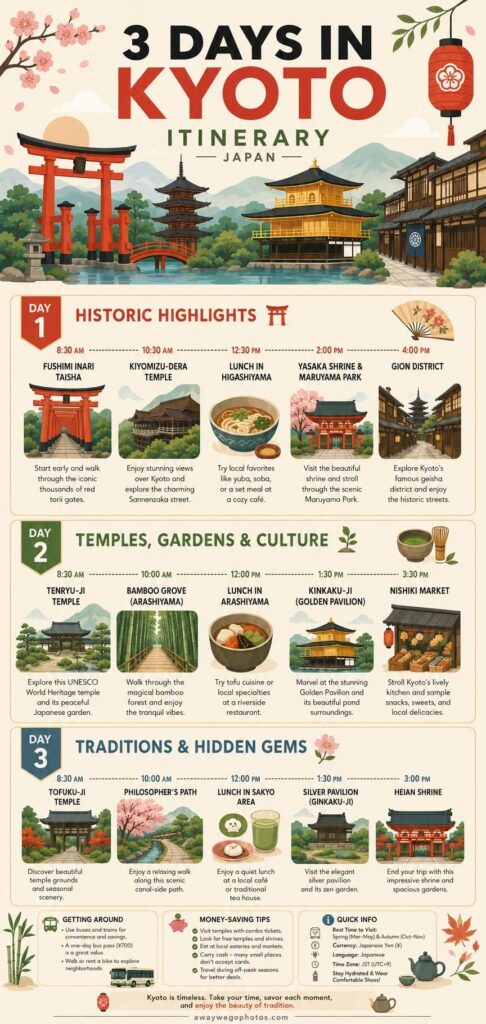
🗺️ 3-Day Kyoto Itinerary at a Glance
📍 Day 1 — Higashiyama, Kiyomizu-dera & Gion
Explore Kyoto’s historic eastern side, including Kiyomizu-dera, traditional streets, Yasaka Shrine, and Gion.
📍 Day 2 — Fushimi Inari, Nijo Castle & Central Kyoto
See the famous torii gates of Fushimi Inari, explore Nijo Castle, and finish with Nishiki Market and central Kyoto.
📍 Day 3 — Kinkaku-ji & Arashiyama
Visit the Golden Pavilion, then spend the afternoon exploring Arashiyama’s bamboo grove, temples, river scenery, and historic streets.
📍 Day 1 — Higashiyama, Kiyomizu-dera & Gion
Your first day focuses on some of Kyoto’s most atmospheric historic areas. Starting early is worthwhile because Higashiyama is one of the city’s busiest sightseeing districts.
🌅 Morning — Kiyomizu-dera
Begin your Kyoto itinerary at Kiyomizu-dera Temple, one of the city’s most important historic temples.
Kiyomizu-dera was founded in 778 and has a history spanning more than 1,250 years. The temple is associated with Kannon, the Buddhist bodhisattva of compassion, and has long attracted visitors from different parts of society.
Aim to arrive around 7:00–7:30 a.m. if possible. Kiyomizu-dera opens at 6:00 a.m., although closing times vary depending on the season and special events.
Allow around 1–1.5 hours to explore.
Look for:
- The famous wooden Main Hall
- The stage overlooking the surrounding area
- Otowa Waterfall
- Temple gates and pagodas
- Views over eastern Kyoto
The walk up to the temple is part of the experience. The approach through Kiyomizu-zaka and surrounding streets is lined with traditional shops, cafés, and souvenir stores
🚶 Late Morning — Sannenzaka & Ninenzaka
After Kiyomizu-dera, walk downhill through Sannenzaka and Ninenzaka.
These historic streets are among the best places in Kyoto to experience traditional architecture. Wooden buildings, tiled roofs, small shops, tea houses, and narrow lanes create the atmosphere many visitors associate with old Kyoto.
Take your time rather than rushing from one attraction to another.
This is also a good opportunity to stop for:
- Matcha tea
- Japanese sweets
- Yatsuhashi, a traditional Kyoto confection
- Matcha-flavored desserts
- Small local snacks
🌿 Discover Kyoto's Classics
Explore Kyoto's beautiful temples and scenery with stops at Fushimi Inari Shrine, Kinkakuji Temple, and Arashiyama's famous Bamboo Grove.
Book Your Trip →🍜 Lunch — Traditional Kyoto Food
For lunch, look for a restaurant serving yudofu, soba, udon, sushi, or a Kyoto-style set meal.
Kyoto is particularly associated with delicate cuisine, seasonal vegetables, tofu, pickles, and dishes that emphasize presentation as well as flavor.
For a more casual experience, choose a small restaurant around Higashiyama rather than spending time traveling across the city for lunch.
🏛️ Afternoon — Yasaka Shrine & Maruyama Park
Continue toward Yasaka Shrine, one of Kyoto’s best-known Shinto shrines.
The shrine sits at the eastern end of Shijo Street and provides a natural transition between Higashiyama and Gion.
After visiting the shrine, walk through Maruyama Park. This gives you a chance to slow down after the busy morning.
If you’re visiting during cherry blossom season, this area can be particularly attractive, although spring is also one of Kyoto’s busiest periods.
🌆 Evening — Gion & Shirakawa
Continue west into Gion, Kyoto’s historic geiko and maiko district.
Gion is best experienced as a neighborhood rather than a checklist of attractions. Walk quietly through its traditional streets and admire the wooden architecture.
Continue toward the Shirakawa area, where the canal, willow trees, stone paths, and traditional buildings create one of Kyoto’s most atmospheric scenes.
Kyoto asks visitors to be particularly respectful in historic geiko districts because these are living neighborhoods rather than theme parks.
Day 1 route:
Kiyomizu-dera → Sannenzaka → Ninenzaka → Yasaka Shrine → Maruyama Park → Gion → Shirakawa
🍜 Day 1 Food
Make the first day about classic Kyoto flavors.
Consider trying:
- Yudofu — simple tofu served with dipping sauces and accompaniments
- Soba — buckwheat noodles
- Obanzai — Kyoto-style home cooking using seasonal ingredients
- Matcha sweets
- Yatsuhashi — a traditional Kyoto confection
📍 Day 2 — Fushimi Inari, Nijo Castle & Central Kyoto
Day two combines one of Kyoto’s most recognizable sights with its political history and traditional food culture.
⛩️ Early Morning — Fushimi Inari Taisha
Start early at Fushimi Inari Taisha, famous for its thousands of vermilion torii gates climbing Mount Inari.
The shrine is in southern Kyoto’s Fushimi district, an area historically connected to transportation, waterways, trade, and sake production. Fushimi remains one of Japan’s major sake-brewing centers.
You don’t need to walk the entire mountain to enjoy the shrine.
Allow approximately 1.5–2.5 hours, depending on how far you want to climb.
The further you walk beyond the busiest lower section, the quieter the trail generally becomes.
🚆 Getting to Fushimi Inari
Fushimi Inari is particularly convenient by train. From Kyoto Station, the official Kyoto tourism guide lists the journey to Fushimi Inari as approximately 10 minutes by rail.
After exploring the shrine, take the train toward central Kyoto.
🏯 Late Morning — Nijo Castle
Next, visit Nijo Castle, an important reminder of Kyoto’s political history.
The castle was constructed in the early 17th century and is closely associated with Tokugawa shogunal power. Its palace buildings, gardens, gates, and decorative interiors provide a different perspective on Kyoto from its temples and shrines.
The official castle currently lists opening hours of 8:45 a.m. to 4:00 p.m., with the castle closing at 5:00 p.m. Some palace areas have separate schedules and closures, so check the official site before visiting.
Allow around 1.5–2 hours.
Pay particular attention to the Ninomaru Palace, gardens, stone walls, and elaborate decorative details.
🍱 Lunch — Central Kyoto
After Nijo Castle, head toward central Kyoto for lunch.
This is a good time to try:
- Kyoto-style sushi
- Soba
- Udon
- Japanese curry
- Seasonal set meals
- Tofu dishes
Keep lunch relatively flexible because the afternoon is centered around Nishiki Market and the surrounding streets.
🛍️ Afternoon — Nishiki Market
Walk toward Nishiki Market, often called the “Kitchen of Kyoto.”
The market stretches for roughly 400 meters between Teramachi and Takakura and has traditionally been associated with fish, vegetables, dried foods, prepared dishes, tofu skin, sweets, and other ingredients used in Kyoto cuisine.
Allow around 1–1.5 hours.
Instead of treating Nishiki Market as a place to eat continuously, use it to explore Kyoto’s food culture.
You may find:
- Pickled vegetables
- Kyoto vegetables
- Tofu products
- Japanese sweets
- Seafood
- Tea
- Traditional seasonings
One important local etiquette point: don’t walk while eating through Nishiki Market. The market is narrow, and the official guidance asks visitors to eat purchases at the shop or designated area rather than while walking.
🌆 Evening — Pontocho & Kamo River
After Nishiki Market, walk toward the Kamo River.
The area around Pontocho and Shijo-Kawaramachi is ideal for an evening walk. You don’t need to make nightlife the focus; simply enjoy the historic streets, river scenery, shops, restaurants, and atmosphere.
Central Kyoto combines old and new, with historic sites such as Nijo Castle alongside shopping streets, restaurants, and traditional districts.
Finish the evening with dinner in central Kyoto.
Day 2 route:
Fushimi Inari → Nijo Castle → Central Kyoto → Nishiki Market → Kamo River → Pontocho
🍜 Day 2 Food
Use the second day to explore Kyoto’s everyday food culture.
Good choices include:
- Kitsune udon
- Soba
- Kyoto-style sushi
- Obanzai
- Pickles
- Matcha desserts
- Seasonal vegetables
Nishiki Market is especially useful for discovering ingredients and small food specialties associated with Kyoto.
📍 Day 3 — Kinkaku-ji & Arashiyama
Your final day moves toward northern and western Kyoto.
Because Kinkaku-ji and Arashiyama are in different parts of the city, don’t try to squeeze several unrelated central Kyoto attractions into the same day. Instead, focus on these two areas and allow time for transportation.
🌅 Morning — Kinkaku-ji, the Golden Pavilion
Start at Kinkaku-ji, officially known as Rokuon-ji.
The temple’s famous Golden Pavilion was originally part of the villa of Ashikaga Yoshimitsu, the third Ashikaga shogun. After his death, the villa was converted into a temple. The site became an important center of the cultural developments associated with the Kitayama period.
Kinkaku-ji is also a UNESCO World Heritage Site.
The temple is currently open 9:00 a.m.–5:00 p.m., although special exhibitions can affect arrangements.
Allow approximately 1–1.5 hours.
The highlight is the Golden Pavilion reflected in the pond, but don’t immediately leave after taking the famous photograph. Follow the garden route and look at the surrounding landscape.
🚍 Getting to Arashiyama
After Kinkaku-ji, travel toward Arashiyama. Because buses can be affected by congestion, allow extra time for this journey.
Kyoto’s official tourism guide specifically recommends combining trains and buses and notes that traffic can make road journeys significantly longer than map estimates suggest.
🎋 Afternoon — Arashiyama Bamboo Grove
Arrive in Arashiyama around lunchtime.
Start with the Arashiyama Bamboo Grove, one of Kyoto’s most recognizable landscapes.
The bamboo path can become extremely crowded, so don’t expect complete solitude. Instead, treat the grove as one part of a larger Arashiyama walk.
The official Kyoto guide also highlights less-touristed areas around Saga and Okusaga for travelers who want to experience a quieter side of the district.
🏯 Tenryu-ji & Historic Arashiyama
Continue to Tenryu-ji, an important Zen temple near the bamboo grove.
Its gardens provide a calmer contrast to the busy bamboo path.
Afterward, walk toward Togetsu-kyo Bridge, one of the area’s most recognizable landmarks.
If you still have energy, continue farther into Saga and consider exploring quieter streets or one additional temple rather than trying to visit every attraction.
Arashiyama includes numerous cultural and scenic attractions beyond the bamboo grove, including Otagi Nenbutsu-ji, Gio-ji, Daikaku-ji, museums, historic sites, and traditional scenery.
🍵 Late Afternoon — Tea & Traditional Sweets
Take a break at a traditional tea house or café.
This is a good point in the itinerary to slow down. After three days of temples, walking, markets, and neighborhoods, you don’t need to add another major attraction.
Enjoy:
- Matcha
- Japanese tea
- Wagashi
- Seasonal Japanese sweets
- Matcha desserts
🌇 Evening — Togetsu-kyo & Arashiyama
Finish your Kyoto itinerary around Togetsu-kyo Bridge and the Katsura River.
The mountains surrounding Arashiyama create a beautiful backdrop, particularly in spring and autumn.
Take your time here rather than rushing back to central Kyoto immediately.
Day 3 route:
Kinkaku-ji → Arashiyama → Bamboo Grove → Tenryu-ji → Togetsu-kyo Bridge → Saga/Arashiyama
🍜 Day 3 Food
For your final day, try a few lighter Kyoto specialties:
- Matcha
- Wagashi
- Yudofu
- Soba
- Seasonal Japanese sweets
- A traditional Japanese set meal
Arashiyama is also a good place for a relaxed tea break rather than another large meal between attractions.
🚇 Getting Around Kyoto
Kyoto is best explored using a combination of trains, buses, subway lines, and walking.
For this itinerary, trains are especially useful for:
- Kyoto Station → Fushimi Inari
- Central Kyoto → other major districts
- Moving between larger areas without relying entirely on buses
Buses remain useful for attractions that are not directly served by rail, but road congestion can make journey times unpredictable.
The official Kyoto travel guide recommends using trains and buses together and provides route-planning tools designed specifically for Kyoto’s traffic conditions.
🚇 Should You Buy a Day Pass?
The Subway & Bus 1-Day Pass currently costs ¥1,100 for adults and allows unlimited rides on the Kyoto subway and participating bus services, with some route exclusions.
However, don’t automatically buy a pass every day. Compare the individual fares with the pass price based on your actual itinerary.
For this three-day itinerary, using individual train tickets or an appropriate IC card can sometimes be simpler.
🏨 Where to Stay in Kyoto
For a three-day Kyoto itinerary, staying somewhere with convenient transportation can save significant time.
📍 Kyoto Station
Best for: First-time visitors and travelers with luggage
Kyoto Station provides excellent connections for trains and makes Day 2’s Fushimi Inari visit particularly convenient.
📍 Downtown Kyoto — Shijo/Kawaramachi
Best for: Food, shopping, central location, and evening walks
This area puts you close to Nishiki Market, the Kamo River, Pontocho, and many restaurants.
📍 Gion / Higashiyama
Best for: Traditional atmosphere and historic streets
Staying here puts you close to Kiyomizu-dera, Yasaka Shrine, and Gion, making an early morning start on Day 1 particularly convenient.
📍 Arashiyama
Best for: Travelers who prefer a quieter, scenic setting
Staying in Arashiyama can be appealing if you want to experience the area before and after the busiest sightseeing hours.
🎟️ Make Exploring Kyoto Easier
Travel between Kyoto’s popular sightseeing spots with a flexible hop-on hop-off bus ticket.
View Ticket →🌤️ Best Time to Visit Kyoto
Kyoto is a year-round destination, but each season creates a very different experience.
🌸 Spring — March to May
Spring brings mild weather and famous cherry blossoms. April is particularly popular, but crowds can be substantial during peak blossom periods.
☀️ Summer — June to August
Summer can be very hot and humid, with temperatures often reaching above 35°C in midsummer. June to mid-July can also bring the rainy season.
If visiting in summer, start sightseeing early and carry water.
🍁 Autumn — September to November
Autumn is one of Kyoto’s most popular seasons because of the colorful foliage. November is particularly associated with vivid autumn leaves, although exact timing varies each year.
❄️ Winter — December to February
Winter is colder and generally quieter. Snow is possible but not especially frequent, and a snowy Kyoto can create beautiful scenes when conditions line up.
💰 Estimated Kyoto Budget
Your spending will vary considerably depending on accommodation, restaurants, and the attractions you choose.
As a general planning range, consider:
- Budget food: roughly $10–20 per meal
- Casual restaurant meal: roughly $15–30
- Local transportation: approximately $5–15 per day depending on how much you travel
- Major paid attractions: commonly several hundred to around 1,000+ yen each
- Comfortable daily spending excluding accommodation: roughly $60–120 per person
These are planning estimates rather than fixed prices. Attraction fees, transportation fares, restaurant prices, and exchange rates can change, so check official websites shortly before your trip.
For reference, Kinkaku-ji currently lists general admission at ¥500, while Kyoto’s Subway & Bus 1-Day Pass is ¥1,100 for adults.
💡 3-Day Kyoto Travel Tips
1. Start early
The most famous temples and neighborhoods become considerably busier later in the morning. Early starts are especially useful at Kiyomizu-dera, Fushimi Inari, and Arashiyama.
2. Wear comfortable shoes
Kyoto is a walking city. Even when using public transportation, you’ll spend considerable time walking between stations, temples, streets, and neighborhoods.
3. Don’t rely entirely on buses
Kyoto buses are useful, but traffic can slow them down. Combine buses with trains, subway services, and walking whenever practical.
4. Respect residential neighborhoods
Many of Kyoto’s famous sightseeing areas are also people’s homes. Keep noise down, avoid blocking roads and entrances, and follow photography restrictions.
5. Don’t eat while walking through Nishiki Market
Eat food at the shop where you bought it or in an appropriate designated area rather than walking through the narrow market while eating.
6. Check attraction schedules before leaving
Opening hours and special closures can vary. This is particularly important for places such as Nijo Castle, where different palace areas can have separate schedules.
7. Leave some flexibility
Kyoto’s attractions can be crowded, buses can be delayed by traffic, and you may discover a street, garden, café, or temple that you want to explore longer.
A good itinerary should have room for that.
❓ 3 Days in Kyoto FAQ
Is 3 days enough for Kyoto?
Yes. Three days is a good amount of time for a first visit. You can cover major attractions such as Kiyomizu-dera, Fushimi Inari, Nijo Castle, Kinkaku-ji, and Arashiyama while still experiencing traditional neighborhoods and local food.
What should I not miss in Kyoto in 3 days?
For a first visit, prioritize Kiyomizu-dera and Higashiyama, Fushimi Inari, Nijo Castle, Kinkaku-ji, and Arashiyama. You can then add Gion, Nishiki Market, and central Kyoto around those major attractions.
Is Kyoto walkable?
Many of Kyoto’s historic neighborhoods are excellent for walking. However, the city is spread out, so public transportation is important when traveling between areas such as Fushimi, Higashiyama, Kinkaku-ji, and Arashiyama.
Should I stay near Kyoto Station or Gion?
Both are convenient. Kyoto Station is particularly useful for transportation, while Gion/Higashiyama is better if you want to be close to historic streets and traditional Kyoto scenery.
Do I need a Kyoto transportation pass?
Not necessarily. Kyoto offers several passes, including a Subway & Bus 1-Day Pass, but the best option depends on your itinerary. Compare the cost of the pass with individual journeys before purchasing.
When is the best time to visit Kyoto?
Spring and autumn are especially popular for pleasant sightseeing conditions and seasonal scenery, but they can also be crowded. Summer is hot and humid, while winter is colder but can offer a quieter experience.
📌 Final Thoughts
Three days in Kyoto gives you a strong introduction to Japan’s former imperial capital without turning your trip into a race between attractions. Start with the historic streets of Higashiyama and Gion, explore Fushimi Inari and Nijo Castle, then finish with Kinkaku-ji and the landscapes of Arashiyama.
The key is to group attractions by area, start early, use trains and buses strategically, and leave time to walk. Kyoto is more than its famous temples: its traditional neighborhoods, food markets, gardens, architecture, and everyday streets are what make the city especially rewarding to explore.
With this 3 Days in Kyoto itinerary, you’ll experience many of the city’s essential highlights while still having time to slow down and enjoy the atmosphere.
🧭 More Kyoto Travel Guides