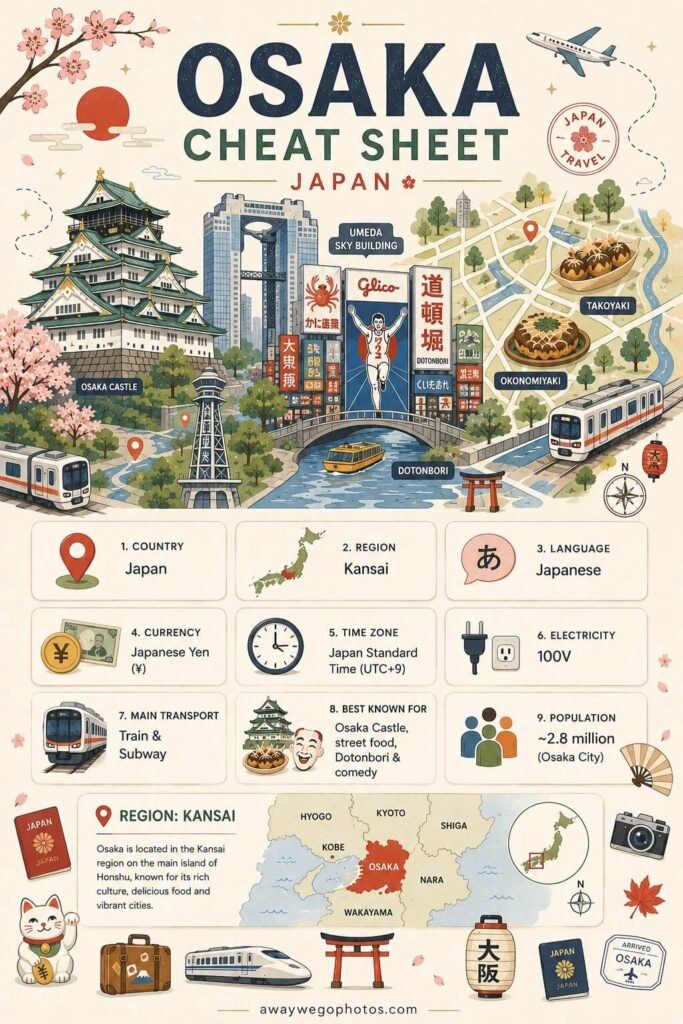
Planning a trip to Osaka, Japan? This quick Osaka Cheat Sheet gives you the essential information you need before and during your visit.
From the best time to visit and how to get around to local customs, currency, food, and useful travel tips, everything is in one easy-to-scan guide.
For official destination information, attractions, events, food, transportation, and travel-planning advice, check the Official Osaka Tourism Guide (OSAKA-INFO).
Affiliate Disclosure: This post contains affiliate links. I may earn a small commission if you book through them, at no extra cost to you.
🗺️ Osaka at a Glance
- Country: Japan
- Region: Kansai
- Language: Japanese
- Currency: Japanese Yen (JPY/¥)
- Time Zone: Japan Standard Time (JST), UTC+9
- Population: Approximately 2.8 million in Osaka City
- Best Known For: Street food, historic landmarks, Osaka Castle, lively neighborhoods, shopping, and its famous food culture
- Main Airport: Kansai International Airport (KIX)
- Typical Trip Length: 2–4 days
🚶 Explore Osaka with an Expert
Discover Osaka's historic and cultural highlights on foot with a native guide who can introduce you to the city beyond the usual tourist stops.
Book Your Tour →📅 Best Time to Visit Osaka
Best overall: March–May and October–November
- 🌸 Spring: Mild temperatures, cherry blossoms, and excellent conditions for sightseeing and walking.
- ☀️ Summer: Hot and humid, with festivals and lively outdoor events. Rain is also more common during the early summer rainy season.
- 🍂 Fall: Comfortable temperatures, colorful autumn foliage, and excellent sightseeing conditions.
- ❄️ Winter: Cool and generally quieter, with fewer crowds and seasonal illuminations.
Best for good weather: March–May and October–November
Best for fewer crowds: January–February and late November–early December
Best for festivals/events: Summer, particularly July and August
💡 Tip: Spring and fall are popular, so expect higher demand for hotels and major attractions during peak periods.
💰 Money & Costs
- Currency: Japanese Yen
- Currency symbol: ¥
- Credit cards: Widely accepted at hotels, department stores, restaurants, and major attractions, but smaller businesses may still prefer cash.
- ATMs: ATMs at convenience stores such as 7-Eleven are useful for international visitors.
- Tipping: Not generally expected in Japan.
- Budget traveler: About ¥6,000–¥10,000 per day, excluding accommodation
- Mid-range traveler: About ¥15,000–¥30,000 per day, excluding accommodation
- Luxury traveler: ¥40,000+ per day, excluding accommodation
💡 Money tip: Keep some cash with you because smaller restaurants, shops, and local businesses may not accept cards.
🚆 Getting Around Osaka
🚇 Public Transportation
Osaka has an extensive public transportation network combining Osaka Metro, JR trains, private railways, and buses. Osaka Metro is particularly useful for traveling between major sightseeing areas in the city.
Useful ticket/pass: ICOCA or other compatible IC cards are convenient for many train and subway journeys. Visitors can also consider Osaka-area sightseeing passes depending on their itinerary.
For current subway information, routes, fares, and service updates, check Osaka Metro Official Website.
🚕 Taxis & Ride-Sharing
Taxis are clean, reliable, and useful when traveling late, carrying luggage, or visiting places that are less convenient by train. They are generally more expensive than public transportation.
🚶 Walking
Osaka is excellent for exploring on foot, particularly around Dotonbori, Namba, Shinsaibashi, Umeda, and Osaka Castle. Combining walking with trains and subways is usually the easiest way to explore.
🚗 Renting a Car
Most visitors do not need a rental car for Osaka. Public transportation is faster and more convenient for the main tourist areas.
💡 Best option for most visitors: Trains and subway + walking
🏨 Where to Stay in Osaka
📍 Namba
Best for: First-time visitors, food lovers, and sightseeing
Namba is one of Osaka’s most convenient bases, with easy access to Dotonbori, Shinsaibashi, Kuromon Market, and numerous restaurants and shops.
📍 Umeda
Best for: Shopping, transportation, and day trips
Umeda is a major transportation hub centered around Osaka Station and offers excellent connections to Kyoto, Kobe, and other destinations in Kansai.
📍 Shinsaibashi
Best for: Shopping and central sightseeing
Shinsaibashi is close to Namba and Dotonbori and is ideal if you want to be within walking distance of shopping streets, restaurants, and major attractions.
📍 Tennoji
Best for: Culture, attractions, and a quieter base
Tennoji offers access to attractions such as Shitennoji, Tennoji Park, and Abeno Harukas while providing convenient rail connections.
💡 First-time visitors: Namba is one of the easiest areas for a first Osaka trip.
🌸 See Kansai's Must-See Sights
Explore three unforgettable destinations—Nara, Fushimi Inari Taisha, and Arashiyama—on a convenient bus tour from Kyoto or Osaka.
Explore the Tour →🍜 What to Eat in Osaka
Don’t leave Osaka without trying:
- 🥞 Okonomiyaki — A savory Japanese pancake traditionally made with cabbage and a variety of toppings.
- 🐙 Takoyaki — Famous Osaka-style batter balls filled with octopus and served with savory toppings.
- 🍜 Kitsune Udon — Udon noodles topped with sweet fried tofu.
- 🍢 Kushikatsu — Deep-fried skewers of meat, seafood, and vegetables.
- 🍣 Osaka-Style Sushi — Pressed sushi, known as hakozushi, traditionally prepared in a wooden mold.
👉 Local food tip: Osaka is famous for its casual food culture, so explore neighborhood restaurants, markets, and food streets rather than relying only on major tourist areas.
Want more food ideas? See my 10 Must-Try Foods in Osaka guide.
🏯 Top Places to See
If you’re visiting Osaka for the first time, consider adding these to your itinerary:
- 🏯 Osaka Castle
- 🐙 Dotonbori
- 🛍️ Shinsaibashi
- 🗼 Tsutenkaku
- 🌆 Umeda Sky Building
The official Osaka tourism guide also provides a searchable collection of attractions, museums, historic sites, parks, and other experiences.
👉 Planning your sightseeing? See our 10 Best Things to Do in Osaka guide.
🗣️ Useful Japanese Phrases
| Japanese | English |
|---|---|
| こんにちは (Konnichiwa) | Hello |
| ありがとうございます (Arigatou gozaimasu) | Thank you |
| すみません (Sumimasen) | Excuse me / Sorry |
| お願いします (Onegaishimasu) | Please |
| いくらですか? (Ikura desu ka?) | How much is it? |
💡 Language tip: English is common in major tourist areas, but learning a few basic Japanese phrases is appreciated.
🙇 Local Customs & Etiquette
Before visiting Osaka, keep these customs in mind:
- Remove your shoes when entering places where it is customary to do so.
- Avoid eating or drinking while walking in situations where it may inconvenience others.
- Keep your voice down on trains and avoid phone calls while riding.
- Queue neatly when waiting for trains, buses, and attractions.
- Do not tip at restaurants or hotels unless specifically instructed.
💡 Osaka-specific tip: On escalators, follow the local standing side and keep the other side clear for people walking. Practices can vary during temporary situations, so follow local signage and other passengers.
📱 Useful Travel Information
- Emergency number: 110 for police; 119 for fire and ambulance
- Tourist information: Tourist information centers are available throughout Osaka.
- Internet/Wi-Fi: Wi-Fi is widely available in hotels, stations, cafés, and tourist facilities.
- SIM/eSIM: Japanese SIM and eSIM options are widely available for travelers.
- Electricity: 100V; Japan uses Type A and Type B plugs.
- Tap water: Safe to drink
- Driving side: Left
- Visa: Entry requirements depend on your nationality. Check current Japanese government requirements before traveling.
Main Airport: Kansai International Airport (KIX)
For current flight information, airport transportation, facilities, and access information, use the Kansai International Airport Official Website.
🎒 What to Pack for Osaka
Your packing list will depend on the season, but consider:
- 👟 Comfortable walking shoes
- 🧥 Light jacket or layers during spring and fall
- ☔ Compact umbrella or rain jacket
- 🔌 Travel adapter
- 📱 Phone + portable charger
- 🎒 Small day bag
⚠️ Things to Know Before Visiting Osaka
A few things that can make your trip easier:
- Osaka’s major attractions are spread across different neighborhoods, so plan your days geographically.
- Public transportation is usually the easiest way to move around the city.
- Carry a small amount of cash even though card payments are widely available.
- Reserve popular restaurants and attractions ahead of time when possible.
- Avoid overpacking your itinerary—Osaka is a city where wandering neighborhoods and discovering local food can be part of the experience.
👉 Planning your itinerary? My 3 Days in Osaka guide can help you organize your sightseeing by day.
⏱️ How Many Days Do You Need in Osaka?
For most travelers, 2–4 days is a good amount of time to experience Osaka’s main attractions while leaving time for food, neighborhoods, and shopping.
- 1 Day: Explore Osaka Castle, Dotonbori, Namba, and Shinsaibashi.
- 3 Days: Add Umeda, Tsutenkaku, Tennoji, markets, museums, and additional neighborhoods.
- 5+ Days: Spend more time exploring Osaka and add day trips to places such as Kyoto, Nara, Kobe, or Himeji.
🔗 Official Travel Resources for Osaka
For the most up-to-date information, check these official resources:
- Osaka Official Tourism Guide — OSAKA-INFO
- Osaka Public Transportation — Osaka Metro
- Kansai International Airport — Kansai International Airport
- Japan Visa & Entry Information — Check the current official Japanese government immigration and visa requirements before traveling.
💡 Tip: Use official websites for current information about transportation, entry requirements, public holidays, events, and travel regulations.
✈️ Osaka Cheat Sheet — Quick Summary
| Essential | Information |
|---|---|
| 🌍 Country | Japan |
| 🗣️ Language | Japanese |
| 💰 Currency | Japanese Yen (JPY/¥) |
| ⏰ Time Zone | JST (UTC+9) |
| 📅 Best Time | March–May & October–November |
| 🚆 Getting Around | Trains, subway & walking |
| 🏨 Best Area | Namba |
| 🍜 Must-Try Food | Okonomiyaki & Takoyaki |
| 💳 Cards | Widely accepted |
| 🔌 Electricity | 100V, Type A/B |
| 🚨 Emergency | 110 Police / 119 Fire & Ambulance |
📌 Final Thoughts
With this Osaka Cheat Sheet, you have the essential information you need to start planning your trip.
From navigating the subway and choosing where to stay to discovering Osaka’s famous food culture and historic landmarks, a little preparation can make exploring the city much easier.
Save this guide for your trip and use it as a quick reference while exploring Osaka.