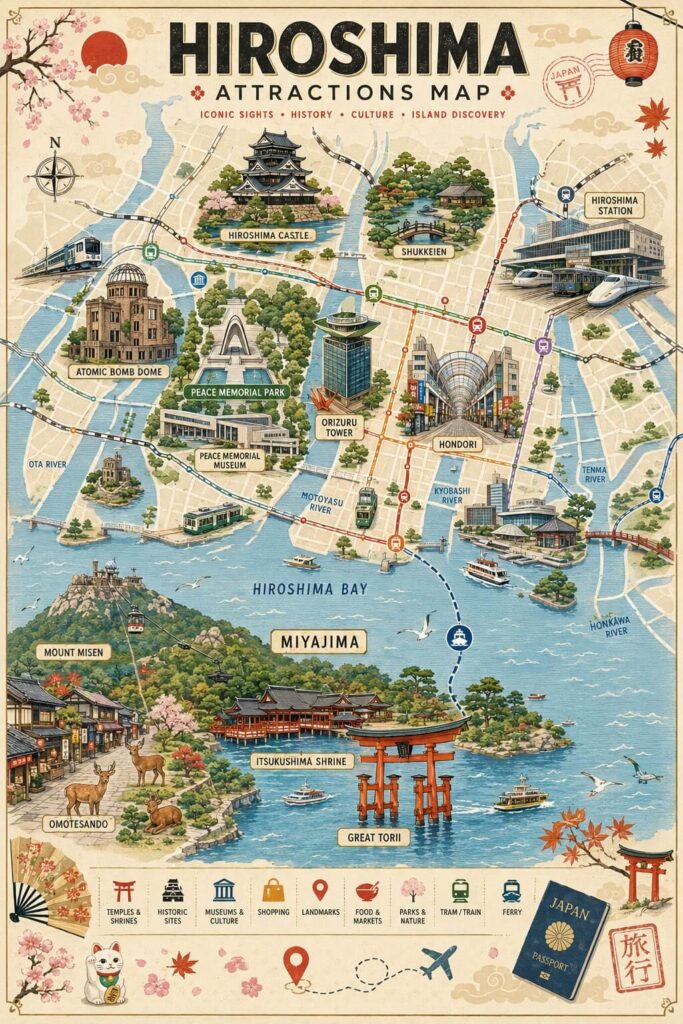
Planning a trip to Hiroshima? This historic Japanese city offers much more than its famous Peace Memorial sites. From important landmarks and traditional gardens to Hiroshima-style food, castle grounds, shopping streets, and the beautiful island of Miyajima, there is plenty to explore.
Hiroshima is a destination where history, culture, nature, and modern Japanese life come together. A visit can take you from the Atomic Bomb Dome and Peace Memorial Park to centuries-old shrines, mountain viewpoints, traditional gardens, and lively downtown streets.
Whether you’re visiting for the first time or returning for another trip, these 10 best things to do in Hiroshima will help you experience some of the city’s most important sights, cultural attractions, local food, and memorable experiences.
Affiliate Disclosure: This post contains affiliate links. I may earn a small commission if you book through them, at no extra cost to you.
🏆 1. Visit Hiroshima Peace Memorial Park
Hiroshima Peace Memorial Park is the most important place to begin understanding the city’s history. Located in central Hiroshima, the park occupies what was once a busy urban district before the atomic bombing of August 6, 1945.
Today, the park is a place for remembrance and reflection. Walking through the grounds, you’ll find the Cenotaph for the A-bomb Victims, Children’s Peace Monument, Peace Bell, Atomic Bomb Memorial Mound, and other memorials.
The park also creates an important visual connection between the Peace Memorial Museum and the Atomic Bomb Dome. Hiroshima City describes this landscape as a symbol of Hiroshima’s message of peace.
Allow yourself plenty of time rather than simply walking through for photographs. The atmosphere is quiet and reflective, and several important sites are within easy walking distance of one another.
Why visit: To understand Hiroshima’s history and its continuing message of peace.
📍 Location: Nakajima-cho, central Hiroshima
⏰ Best time to visit: Morning or late afternoon
💡 Tip: Combine the park with the Peace Memorial Museum and Atomic Bomb Dome since they are close together.
🌿 Walk Through Hiroshima
Take a meaningful walk through Hiroshima while learning about its history, resilience, and transformation from a local perspective.
Explore the Tour →🕊️ 2. See the Atomic Bomb Dome
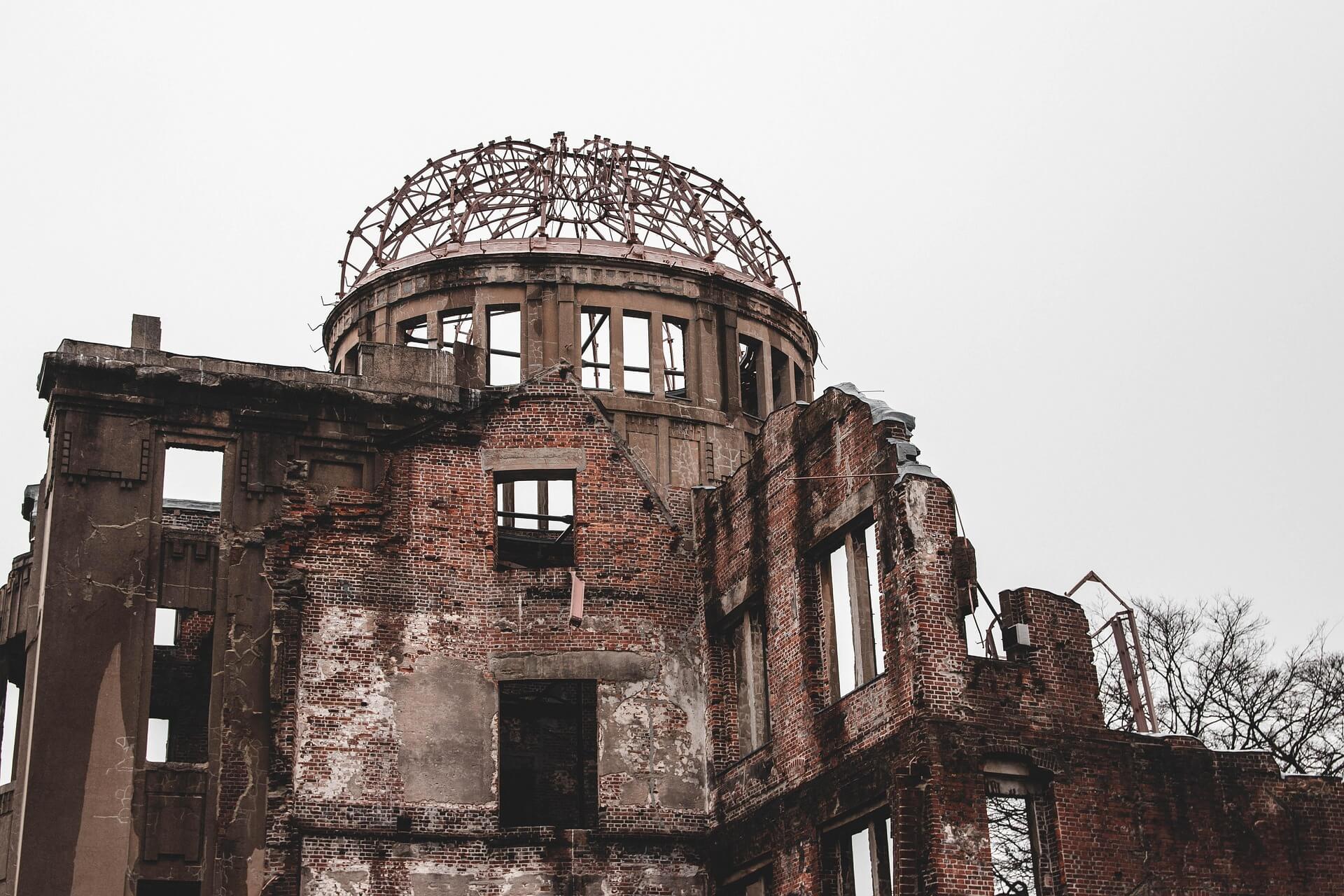
Standing beside the Motoyasu River, the Atomic Bomb Dome is one of Hiroshima’s most recognizable landmarks.
The building was originally the Hiroshima Prefectural Industrial Promotion Hall, designed by Czech architect Jan Letzel and completed in 1915. On August 6, 1945, it was exposed to the atomic bombing at very close range. Much of the building was destroyed, but portions of its structure remained standing.
After the war, the ruins became known as the Atomic Bomb Dome. Hiroshima decided to preserve the structure rather than demolish it, and in 1996 it was registered as a UNESCO World Heritage Site.
Today, visitors view the Dome from outside the surrounding fence. Its partially destroyed structure provides a powerful contrast to the modern city that surrounds it.
Why visit: To see one of Hiroshima’s most important historical symbols.
📍 Location: Along the Motoyasu River, Peace Memorial Park
⏰ Best time to visit: Early morning or evening for a quieter atmosphere
💡 Tip: Walk along the river and photograph the Dome from several angles rather than viewing it only from the main road.
🏛️ 3. Explore the Hiroshima Peace Memorial Museum
The Hiroshima Peace Memorial Museum is one of the city’s most significant museums and an important stop for travelers who want to understand what happened in Hiroshima in 1945.
The museum presents historical material, photographs, personal belongings, and survivor experiences related to the atomic bombing. The exhibits can be emotionally difficult, so allow yourself enough time to take them in thoughtfully.
For many visitors, the museum provides context that makes the surrounding Peace Memorial Park and Atomic Bomb Dome much more meaningful. Hiroshima also maintains a guide to other A-bombed buildings, trees, and peace-related sites around the city.
Because it is one of Hiroshima’s most visited attractions, it’s worth checking the official website before your visit for current opening information and ticket arrangements. During particularly busy periods, advance web tickets can be useful.
Why visit: To learn about Hiroshima’s history through firsthand accounts and historical exhibits.
📍 Location: Peace Memorial Park
⏰ Best time to visit: Morning
💡 Tip: Visit the museum before exploring the rest of the Peace Memorial Park so the surrounding memorials have more historical context.
⛩️ 4. Visit Itsukushima Shrine on Miyajima
A trip to Hiroshima isn’t complete without visiting Miyajima, the island famous for its beautiful Itsukushima Shrine and floating torii gate.
Itsukushima Shrine has a long history dating back to the 6th century, while the shrine complex became particularly important during the Heian period under the influence of Taira no Kiyomori. The shrine’s distinctive architecture appears to extend over the water, creating one of Japan’s most recognizable landscapes.
The island itself is also worth exploring beyond the shrine. Walk through the traditional streets, browse souvenir shops, sample local foods, and enjoy the views across the Seto Inland Sea.
The famous O-torii gate stands offshore and is especially impressive when viewed with the changing tide.
Why visit: To experience one of Japan’s most iconic shrines and scenic island landscapes.
📍 Location: Miyajima Island, Hatsukaichi
⏰ Best time to visit: Morning to afternoon
💡 Tip: Check the tide times before visiting if you want to see the torii gate surrounded by water.
🏔️ 5. Go to the Top of Mount Misen
For some of the best views around Hiroshima, head up Mount Misen on Miyajima.
Located in the center of the island, Mount Misen combines spectacular scenery with centuries of Buddhist history. The mountain is associated with Kobo Daishi and contains several religious sites, including Misen Hondo and Reikado Hall.
At the summit, visitors can enjoy panoramic views across Miyajima, Hiroshima Bay, and the surrounding islands. The official Miyajima Tourist Association notes that on clear days, views can extend toward the mountains of Shikoku.
You can use the Miyajima Ropeway for part of the journey and continue toward the summit on foot. If you plan to hike, wear suitable footwear and carry water. The official mountain guide also recommends avoiding late-afternoon hiking because daylight can disappear quickly.
Why visit: For panoramic views, hiking, and a deeper connection with Miyajima’s natural and spiritual landscape.
📍 Location: Miyajima Island
⏰ Best time to visit: Morning or early afternoon
💡 Tip: Check the ropeway operating schedule and weather conditions before heading up.
🏯 6. Explore Hiroshima Castle
Hiroshima Castle offers a different perspective on the city’s history. Originally built as a flatland castle, it became an important center of the Hiroshima domain.
The castle was destroyed by the atomic bombing in 1945, but its tower was reconstructed in 1958 as part of Hiroshima’s postwar recovery. The surrounding grounds now provide a peaceful green space in the middle of the city.
The castle grounds are particularly pleasant during spring when cherry blossoms appear around the moat. The reconstructed areas also help visitors understand Hiroshima’s history before the modern city developed.
Why visit: To explore Hiroshima’s samurai-era history and see an important symbol of the city’s reconstruction.
📍 Location: Moto-machi, central Hiroshima
⏰ Best time to visit: Morning or late afternoon
💡 Tip: Combine the castle with Shukkeien Garden since both attractions are relatively close.
🌆 7. Walk Through Hondori Shopping Street
For a glimpse of modern Hiroshima, spend some time walking through Hondori Shopping Street.
This covered pedestrian shopping area stretches through the heart of downtown and is filled with shops, restaurants, cafés, souvenirs, fashion stores, and everyday Japanese businesses.
It’s a nice change of pace after visiting Hiroshima’s historical attractions. Instead of focusing only on the city’s past, Hondori lets you experience contemporary Hiroshima and see where locals shop, eat, and spend time.
The shopping street also connects naturally with other central areas, making it easy to combine with downtown restaurants and Hiroshima-style okonomiyaki.
Why visit: To experience everyday city life, shopping, restaurants, and central Hiroshima.
📍 Location: Downtown Hiroshima
⏰ Best time to visit: Afternoon or early evening
💡 Tip: Explore the side streets around Hondori as well as the main covered arcade.
🏯 Hiroshima's UNESCO Highlights
Experience the history and beauty of Hiroshima and Miyajima with a convenient 1-day tour featuring two of Japan's best-known UNESCO sites.
Check Availability →🍁 8. Relax at Shukkeien Garden
If you need a break from Hiroshima’s busy city center, visit Shukkeien Garden, a traditional Japanese landscape garden dating back to the Edo period.
The garden was created in 1620 for the Asano family, the feudal rulers of Hiroshima, and was designed as a place for relaxation and appreciation of nature. Its name is often associated with the idea of a “shrunken scenery,” reflecting the garden’s miniature landscapes.
Paths wind around ponds, bridges, trees, small hills, and carefully arranged landscapes. The garden changes character throughout the year, making it a pleasant stop during any season.
Current official information lists opening hours of 9:00 AM–6:00 PM from March 16 to September 15 and 9:00 AM–5:00 PM from September 16 to March 15, with the last admission 30 minutes before closing.
Why visit: For traditional Japanese gardens, peaceful scenery, and a relaxing break from sightseeing.
📍 Location: Kaminobori-cho, near Hiroshima Station
⏰ Best time to visit: Morning or late afternoon
💡 Tip: Allow around an hour to walk around the garden at a relaxed pace.
🍜 9. Eat Hiroshima-Style Okonomiyaki
One of the best things to do in Hiroshima is simply eat.
Hiroshima-style okonomiyaki is different from the style commonly associated with Osaka. Instead of mixing the ingredients together, Hiroshima’s version is built in layers.
A thin layer of batter is followed by cabbage, bean sprouts and other ingredients, with noodles added as another important layer. The finished dish is cooked on a large hot plate and topped with Hiroshima-style sauce and other toppings.
For an easy introduction, head to Okonomi-mura, a popular food destination where numerous okonomiyaki restaurants are gathered together. The official Hiroshima tourism guide currently lists 23 okonomiyaki restaurants there.
Watching the chefs prepare your meal directly on the hot plate is part of the experience.
Why visit: To try one of Hiroshima’s signature foods and experience a classic local dining tradition.
📍 Location: Downtown Hiroshima
⏰ Best time to visit: Lunch or dinner
💡 Tip: Go hungry and try Hiroshima-style okonomiyaki freshly prepared on the griddle.
🛕 10. Visit Daisho-in Temple on Miyajima
Before leaving Miyajima, make time for Daisho-in Temple, one of the island’s most important Buddhist temples.
The temple is associated with Shingon Buddhism and has a long history connected with Miyajima and Itsukushima Shrine. The Miyajima Tourist Association describes Daisho-in as one of the most prestigious Shingon temples in western Japan.
The temple complex has a very different atmosphere from the crowded streets around Itsukushima Shrine. Visitors can explore its halls, religious statues, stairways, and peaceful surroundings while learning more about Miyajima’s Buddhist traditions.
Its location also makes it an excellent addition to a Miyajima walking route.
Why visit: For Buddhist architecture, religious history, and a quieter side of Miyajima.
📍 Location: Miyajima Island
⏰ Best time to visit: Morning or afternoon
💡 Tip: Wear comfortable shoes because you’ll encounter stairs and uneven paths around the temple.
🗺️ How to Plan Your Hiroshima Visit
If you only have 1 day in Hiroshima, prioritize:
① Peace Memorial Park → ② Atomic Bomb Dome → ③ Peace Memorial Museum → ④ Hiroshima-style Okonomiyaki
This gives you a good introduction to Hiroshima’s history, its most important memorial sites, and its famous local food.
If you have 2–3 days, add:
⑤ Miyajima & Itsukushima Shrine → ⑥ Mount Misen → ⑦ Daisho-in Temple
A full day on Miyajima is worthwhile if you want to see Itsukushima Shrine, explore the island, visit Daisho-in, and go up Mount Misen.
If you have 4+ days, consider adding:
⑧ Hiroshima Castle → ⑨ Shukkeien Garden → ⑩ Hondori Shopping Street
You can slow down your sightseeing and spend more time exploring Hiroshima’s neighborhoods, gardens, food scene, and historical attractions.
📌 Quick Tips for Visiting Hiroshima
- 🚶 Getting around: Hiroshima is relatively easy to explore using streetcars, buses, and walking. The Hiroshima Electric Railway operates streetcar routes through the city and toward Miyajima, while sightseeing passes can combine different forms of transportation.
- 🎟️ Tickets: Check official attraction websites before visiting, especially for the Peace Memorial Museum and Miyajima Ropeway. Popular attractions can become busy during peak travel periods.
- 🌤️ Best time to visit: Spring and autumn are particularly pleasant for sightseeing. Spring brings cherry blossoms, while autumn offers colorful foliage. Summer can be hot and humid.
- 💰 Budget: Hiroshima can be visited on a moderate budget. Walking between central attractions can help keep transportation costs down, while local restaurants offer a range of affordable meals.
- 👟 What to wear: Wear comfortable walking shoes. This is particularly important if you’re exploring Miyajima or hiking Mount Misen.
- 📱 Useful tip: Check the tide times before visiting Itsukushima Shrine if seeing the torii gate surrounded by water is important to you. Miyajima’s official tourism website provides current tide information.
📌 Final Thoughts
From the Atomic Bomb Dome and Peace Memorial Park to the beautiful landscapes of Miyajima, Hiroshima offers a fascinating combination of history, culture, food, architecture, and nature.
The city deserves more than a quick stop. Take time to understand its history, explore its traditional attractions, eat Hiroshima-style okonomiyaki, and venture beyond the city center to Miyajima.
Whether you’re visiting for one day or several days, these 10 best things to do in Hiroshima provide a great starting point for experiencing the city’s most important attractions and discovering what makes Hiroshima such a memorable destination.