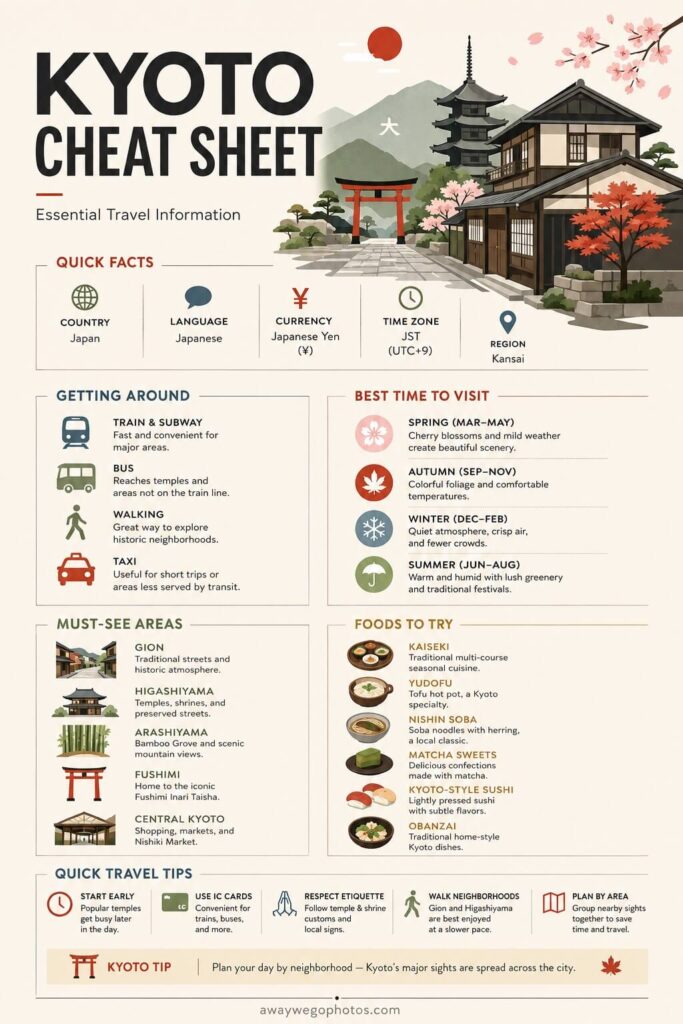
Planning a trip to Kyoto? This quick Kyoto Cheat Sheet gives you the essential information you need before and during your visit.
From the best time to visit and how to get around to local customs, currency, food, and useful travel tips, everything is in one easy-to-scan guide.
🗺️ Kyoto at a Glance
- Country: Japan
- Region: Kansai
- Language: Japanese
- Currency: Japanese Yen (JPY / ¥)
- Time Zone: Japan Standard Time (JST, UTC+9)
- Population: Approximately 1.4 million
- Best Known For: Historic temples and shrines, traditional neighborhoods, gardens, Japanese culture, seasonal scenery, and Kyoto cuisine
- Main Airport: Kansai International Airport (KIX)
- Typical Trip Length: 3–4 days
Kyoto is one of Japan’s most important cultural destinations and was the country’s imperial capital for more than 1,000 years. Today, it is best known for its historic temples, traditional architecture, gardens, festivals, and distinctive food culture.
📅 Best Time to Visit Kyoto
Best overall: March–May and October–November
- 🌸 Spring: Mild weather, cherry blossoms, seasonal flowers, and beautiful temple gardens. Late March to early April is especially popular for cherry blossoms.
- ☀️ Summer: Hot, humid, and sometimes rainy. July and August can be particularly hot, but summer festivals such as Gion Matsuri make this an interesting time to visit.
- 🍂 Fall: Mild weather and spectacular autumn foliage, especially in November. Popular areas can become very busy.
- ❄️ Winter: Cold but generally quieter. Snow is relatively uncommon, but snowy temple landscapes can be spectacular when it occurs.
Kyoto’s official tourism guide identifies spring and autumn as the most comfortable seasons for sightseeing. The biggest crowds generally occur around cherry blossom season in late March–early April and autumn foliage season from mid-November to early December.
Best for good weather: April–May and October–November
Best for fewer crowds: January–February and parts of June
Best for festivals/events: July for Gion Matsuri and October for Jidai Matsuri
💰 Money & Costs
- Currency: Japanese Yen
- Currency symbol: ¥
- Credit cards: Widely accepted, especially at hotels, department stores, major restaurants, and tourist attractions, but smaller businesses may still prefer cash
- ATMs: Convenient-store ATMs and Japan Post Bank ATMs are useful options for international visitors
- Tipping: Not generally expected in Japan
- Budget traveler: Approximately ¥8,000–¥15,000 per day, excluding accommodation
- Mid-range traveler: Approximately ¥15,000–¥30,000 per day, excluding accommodation
- Luxury traveler: ¥30,000+ per day, excluding accommodation
💡 Money tip: Carry some cash even if you mainly use cards. Small restaurants, traditional shops, temples, and other smaller businesses may not accept credit cards.
🚆 Getting Around Kyoto
🚇 Public Transportation
Kyoto has an extensive transportation network consisting of subways, trains, buses, and private railway lines.
The subway is particularly useful for moving through central Kyoto, while trains are often the fastest option for destinations such as Fushimi Inari, Arashiyama, and areas outside the city center. Buses connect many attractions that are not directly served by rail.
Useful ticket/pass: Subway & Bus 1-Day Pass
The current adult price is ¥1,100 and the pass provides unlimited travel on eligible Kyoto subway and bus services for one day.
However, don’t automatically buy a day pass every day. Depending on your itinerary, individual fares or an IC card can be better value.
🚕 Taxis & Ride-Sharing
Taxis are widely available and can be useful when traveling between attractions that are awkward to connect by public transportation. They can also save time when traveling with luggage or in a small group.
🚶 Walking
Walking is one of the best ways to experience Kyoto. Gion, Higashiyama, Pontocho, the Philosopher’s Path, and central Kyoto are particularly rewarding on foot.
Expect to walk considerably during a sightseeing day, especially when visiting temples and shrines.
🚗 Renting a Car
Most visitors do not need a rental car for a typical Kyoto trip. Parking can be inconvenient around major attractions, while trains, buses, and taxis provide better options for most sightseeing.
A car can be useful for exploring rural areas outside central Kyoto, but it is generally unnecessary for a first visit.
💡 Best option for most visitors: Combine trains, subway, buses, and walking. Kyoto’s official tourism guidance specifically recommends using trains and buses together to make sightseeing more efficient and help avoid congestion.
🏨 Where to Stay in Kyoto
📍 Gion & Higashiyama
Best for: First-time visitors and traditional Kyoto atmosphere
This is one of the most atmospheric parts of Kyoto, with historic streets, traditional wooden buildings, temples, shrines, and easy access to attractions such as Kiyomizu-dera and Yasaka Shrine.
📍 Kawaramachi & Downtown Kyoto
Best for: Restaurants, shopping, central location, and convenience
Central Kyoto offers plenty of restaurants, shops, cafés, and transportation connections. It is a convenient base for visitors who want easy access to different parts of the city.
📍 Kyoto Station
Best for: Transportation and day trips
Staying around Kyoto Station is particularly convenient if you plan to take trains to destinations outside the city or arrive with luggage. The station area also has numerous hotels, restaurants, and shopping facilities.
📍 Arashiyama
Best for: Nature, temples, and a quieter atmosphere
Arashiyama is famous for its bamboo grove, mountains, temples, and riverside scenery. It can be a peaceful place to stay, although it is farther from many attractions in central and eastern Kyoto.
💡 First-time visitors: Gion/Higashiyama or central Kyoto are excellent choices if you want a balance of sightseeing, atmosphere, restaurants, and transportation.
🍜 What to Eat in Kyoto
Don’t leave Kyoto without trying:
- 🍵 Matcha — Kyoto is famous for high-quality green tea, especially around Uji and southern Kyoto.
- 🍲 Yudofu — Simple tofu simmered in hot water or broth, traditionally associated with Kyoto’s temple districts.
- 🍱 Kaiseki — An elaborate multi-course dining experience emphasizing seasonal ingredients and presentation.
- 🥬 Obanzai — Traditional Kyoto home-style dishes using seasonal vegetables and local ingredients.
- 🍡 Yatsuhashi — A famous Kyoto sweet, available in baked and soft versions, often flavored with cinnamon.
👉 Local food tip: Kyoto’s food culture is strongly seasonal, so look for dishes featuring ingredients associated with the current season.
Want more food ideas? See my 10 Must-Try Foods in Kyoto guide.
🏯 Top Places to See
If you’re visiting Kyoto for the first time, consider adding these to your itinerary:
- 🏯 Kinkaku-ji (Golden Pavilion)
- ⛩️ Fushimi Inari Taisha
- 🌳 Arashiyama Bamboo Grove
- 🏯 Kiyomizu-dera
- 🏮 Gion & Higashiyama
Other worthwhile additions include Nijō Castle, Ginkaku-ji, the Philosopher’s Path, Nishiki Market, and Kyoto Imperial Palace.
👉 Planning your sightseeing? See my 10 Best Things to Do in Kyoto guide.
🗣️ Useful Japanese Phrases
| Japanese | English |
|---|---|
| こんにちは (Konnichiwa) | Hello |
| ありがとうございます (Arigatō gozaimasu) | Thank you |
| すみません (Sumimasen) | Excuse me / Sorry |
| お願いします (Onegaishimasu) | Please |
| いくらですか? (Ikura desu ka?) | How much is it? |
💡 Language tip: English is common in major tourist areas, but learning a few simple Japanese phrases is appreciated. A translation app can also be extremely useful when communicating outside major tourist areas.
🙇 Local Customs & Etiquette
Before visiting Kyoto, keep these customs in mind:
- Remove your shoes when entering places where this is requested, including some traditional restaurants and accommodations.
- Keep your voice low and behave respectfully inside temples and shrines.
- Do not touch religious objects, statues, artwork, or other cultural properties unless explicitly permitted.
- Avoid eating while walking in crowded areas or around religious sites.
- Follow photography restrictions and posted signs, particularly inside temples, shrines, and traditional establishments.
💡 Kyoto tip: Respect residential neighborhoods and avoid blocking narrow streets while taking photographs. Kyoto asks visitors to help preserve the city’s cultural heritage and quality of life.
📱 Useful Travel Information
- Emergency number: 110 for police; 119 for fire and ambulance
- Tourist information: Kyoto Tourist Information Center “Kyo Navi” at Kyoto Station provides maps, transportation information, and multilingual assistance
- Internet/Wi-Fi: Wi-Fi is available at many hotels, stations, cafés, and tourist facilities
- SIM/eSIM: Japanese SIM and eSIM options are widely available; arrange one before departure or purchase after arrival
- Electricity: 100V, Type A plugs; western Japan, including Kyoto, uses 60Hz
- Tap water: Safe to drink
- Driving side: Left
- Visa: Entry and visa requirements depend on your nationality and purpose/length of stay; check Japan’s official immigration and foreign affairs information before traveling
Kyoto’s Kyo-Navi tourist information center is located on the second floor of Kyoto Station and offers transportation and sightseeing assistance, including English-language support.
Japan uses 100V electricity and Type A outlets; Kyoto is in the 60Hz frequency region.
For emergencies, Japan uses 110 for police and 119 for fire/ambulance. The Japan Visitor Hotline also provides 24-hour assistance in English, Chinese, and Korean.
🎒 What to Pack for Kyoto
Your packing list will depend on the season, but consider:
- 👟 Comfortable walking shoes
- 🧥 Light layers in spring and fall; a warm coat in winter
- ☔ Compact umbrella or lightweight rain jacket
- 🔌 Type A travel adapter if needed
- 📱 Phone + portable charger
- 🎒 Small day bag
💡 Packing tip: Comfortable shoes are particularly important because Kyoto sightseeing often involves substantial walking between train stations, streets, temples, gardens, and historic districts.
⚠️ Things to Know Before Visiting Kyoto
A few things that can make your trip easier:
- Start early: Popular attractions such as Fushimi Inari and Arashiyama can become very busy later in the day.
- Use trains when possible: Trains can often be faster than buses during busy periods.
- Don’t rely exclusively on buses: Combine buses with trains and the subway to avoid unnecessary traffic delays.
- Carry some cash: Smaller restaurants and traditional businesses may not accept cards.
- Respect residential areas: Kyoto is a living city, not simply a tourist attraction. Keep noise down and avoid blocking streets or private entrances.
💡 Crowd tip: Cherry blossom season and autumn foliage season are particularly busy, so consider visiting major attractions early in the morning and exploring less crowded areas during peak hours.
⏱️ How Many Days Do You Need in Kyoto?
For most travelers, 3–4 days is a good amount of time to experience Kyoto’s major attractions without rushing.
- 1 Day: Focus on one area, such as Higashiyama and Gion, or Arashiyama.
- 3 Days: See major highlights including Fushimi Inari, Kiyomizu-dera, Gion, Kinkaku-ji, Arashiyama, and central Kyoto.
- 5+ Days: Explore Kyoto at a slower pace and add areas such as Ohara, Kurama, Kibune, Takao, Fushimi, and additional temples and gardens.
👉 Planning a trip? See our 3 Days in Kyoto itinerary for a day-by-day plan.
🔗 Official Travel Resources for Kyoto
For the most up-to-date information, check these official resources:
- Kyoto Official Travel Guide — Kyoto Travel
- Kyoto Transportation Information — Kyoto Travel – Getting Around Kyoto
- Kansai International Airport — Kansai International Airport
- Japan Visa & Entry Information — Ministry of Foreign Affairs of Japan
💡 Tip: Use official websites for current information about transportation, entry requirements, public holidays, events, and travel regulations.
✈️ Kyoto Cheat Sheet — Quick Summary
| Essential | Information |
| 🌍 Country | Japan |
| 🗣️ Language | Japanese |
| 💰 Currency | Japanese Yen (JPY / ¥) |
| ⏰ Time Zone | JST (UTC+9) |
| 📅 Best Time | March–May & October–November |
| 🚆 Getting Around | Trains, subway, buses & walking |
| 🏨 Best Area | Gion/Higashiyama or Central Kyoto |
| 🍜 Must-Try Food | Kaiseki, yudofu & matcha |
| 💳 Cards | Widely accepted, but carry cash |
| 🔌 Electricity | 100V, Type A, 60Hz |
| 🚨 Emergency | Police 110 / Fire & Ambulance 119 |
📌 Final Thoughts
With this Kyoto Cheat Sheet, you have the essential information you need to start planning your trip.
Kyoto is best experienced at a relaxed pace. Give yourself time to explore historic neighborhoods, visit temples and gardens, try local food, and simply enjoy the atmosphere beyond the major tourist attractions.
Save this guide for your trip and use it as a quick reference while exploring Kyoto.