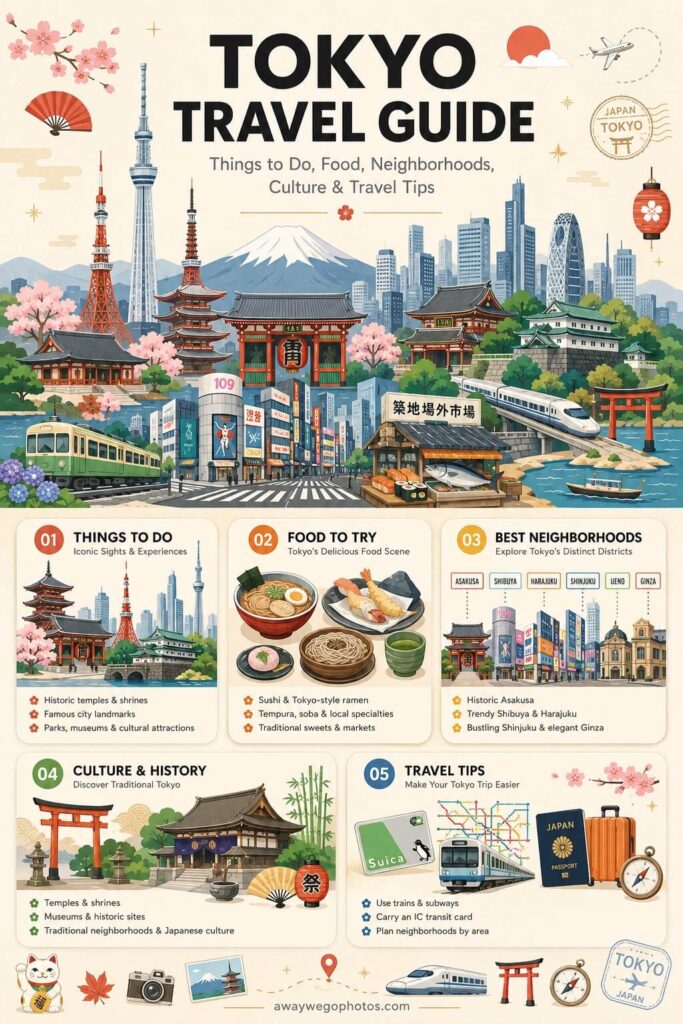
Planning a trip to Tokyo? Japan’s capital combines centuries of history with modern architecture, world-famous food, traditional neighborhoods, shopping districts, museums, gardens, and an incredibly efficient transportation network.
From the historic streets of Asakusa to the bright lights of Shibuya, Tokyo offers a huge variety of experiences. You can visit ancient temples in the morning, explore a traditional market at lunchtime, and finish the day surrounded by skyscrapers and neon.
This Tokyo Travel Guide covers the essential information you need to plan your trip, including the best things to do, food to try, neighborhoods, transportation, costs, where to stay, travel tips, day trips, and suggested itineraries.
📌 Tokyo Travel Guide at a Glance
- 🌍 Country: Japan
- 🗣️ Language: Japanese
- 💴 Currency: Japanese Yen (JPY/¥)
- 🕐 Time Zone: Japan Standard Time (JST), UTC+9
- 🌤️ Best Time to Visit: Spring and autumn
- 🚇 Getting Around: Trains, subway, buses, walking, taxis
- 💵 Average Daily Budget: About $60–$250+ per person, depending on travel style
- 📅 Recommended Stay: 3–5 days
Tokyo is nine hours ahead of GMT and does not observe daylight saving time.
🗺️ Best Things to Do in Tokyo
Tokyo is enormous, so trying to see everything in one trip isn’t realistic. Instead, concentrate on a few neighborhoods each day.
🏯 1. Visit Senso-ji Temple in Asakusa
Senso-ji is one of Tokyo’s most famous landmarks and the oldest temple in the city.
Start at Kaminarimon, the impressive entrance gate with its huge red lantern, then walk along Nakamise-dori, a historic shopping street filled with souvenir shops and traditional snacks.
The temple and surrounding streets are particularly good for experiencing a more traditional side of Tokyo.
🚶 2. Experience Shibuya Crossing
Few places represent modern Tokyo better than Shibuya Crossing.
When the traffic lights stop vehicles, pedestrians cross the intersection from several directions at once. After seeing the crossing, explore the surrounding streets for shopping, cafés, restaurants, fashion, and entertainment.
Shibuya is also home to SHIBUYA SKY, a 229-meter-high open-air observation deck with panoramic city views.
⛩️ 3. Walk Through Meiji Shrine
Just a short distance from the busy streets of Harajuku, Meiji Jingu offers a peaceful change of atmosphere.
The shrine is surrounded by a large forested area created with trees donated from throughout Japan. It’s a great place to combine Tokyo’s modern Harajuku district with a traditional Japanese shrine experience.
🛍️ 4. Explore Harajuku
Harajuku is known for youth fashion, colorful street culture, cafés, shopping, and creative experiences.
Walk along Takeshita Street, then explore the quieter streets around Omotesando and Cat Street.
Harajuku is also convenient to combine with Meiji Shrine because the attractions are close together.
🎮 5. Discover Akihabara
Akihabara is Tokyo’s famous center for electronics, anime, manga, video games, and Japanese pop culture.
Even if you’re not particularly interested in anime or gaming, the bright signs and distinctive atmosphere make the neighborhood worth exploring.
👉 For a more detailed list, see our 10 Best Things to Do in Tokyo guide.
🏛️ Explore Tokyo’s History & Culture
Tokyo is much more than skyscrapers and technology.
The city developed from Edo, the former name of Tokyo, and many neighborhoods still preserve connections to the city’s past.
🏯 Historic Sites
Some of the best places to explore Tokyo’s history include:
- Senso-ji Temple
- Meiji Shrine
- Imperial Palace
- Nezu Shrine
- Hamarikyu Gardens
- Yanaka
🏛️ Museums
Tokyo has museums covering everything from Japanese history and art to science and modern culture.
Consider visiting:
- Tokyo National Museum
- Edo-Tokyo Museum
- National Museum of Nature and Science
- Mori Art Museum
- National Museum of Modern Art, Tokyo
🏘️ Historic Neighborhoods
For a quieter look at Tokyo, explore areas such as Asakusa, Yanaka, Ueno, and Kagurazaka.
These neighborhoods can provide a different experience from the highly developed districts around Shinjuku and Shibuya.
🎎 Cultural Experiences
Depending on your interests, you can experience:
- Traditional temples and shrines
- Japanese gardens
- Tea culture
- Sumo
- Kabuki
- Traditional crafts
- Japanese festivals
- Local markets
Tokyo’s official tourism guide also maintains an updated calendar of festivals, exhibitions, cultural performances, and other events.
🎟️ Book a Tour
Step into Japan’s fascinating past on the Imperial Palace: A Walk Through Japanese History tour. Discover historic landmarks and learn about the history and traditions surrounding Tokyo’s Imperial Palace.
Book the Tour →🍜 What to Eat in Tokyo
Tokyo is one of the world’s great food destinations, and you don’t need to spend a fortune to eat well.
Some dishes and foods to look for include:
- 🍣 Edomae Sushi — Tokyo-style sushi emphasizing fresh seafood and traditional preparation.
- 🍜 Tokyo Ramen — Tokyo has many ramen styles, with shoyu-based ramen being particularly associated with the city.
- 🍤 Tempura — Seafood and vegetables lightly battered and fried.
- 🥘 Monjayaki — A Tokyo specialty particularly associated with Tsukishima.
- 🍢 Yakitori — Grilled chicken skewers commonly enjoyed at casual restaurants and eateries.
- 🍚 Fukagawa-Meshi — A traditional Tokyo dish featuring clams and rice.
- 🥋 Chanko-nabe — A hearty hot pot traditionally associated with sumo wrestlers.
- 🍛 Japanese Curry — A popular everyday Japanese comfort food.
- 🍡 Wagashi — Traditional Japanese sweets often enjoyed with tea.
Don’t limit yourself to famous restaurants. Small neighborhood restaurants, department-store food halls, markets, and casual eateries can all be excellent places to discover Tokyo’s food culture.
👉 See our 10 Must-Try Foods in Tokyo guide for a more detailed food guide.
🏘️ Best Areas & Neighborhoods in Tokyo
Tokyo’s neighborhoods can feel like separate cities, each with its own personality.
🏯 Asakusa
Best for: History and traditional Tokyo
Asakusa is one of the best areas for first-time visitors interested in Tokyo’s historic side. Senso-ji, Nakamise-dori, traditional shops, restaurants, and nearby attractions make it easy to spend several hours here.
🛍️ Shibuya
Best for: Modern Tokyo, shopping and city views
Shibuya is energetic and modern, with Shibuya Crossing, department stores, fashion, restaurants, and attractions such as SHIBUYA SKY.
🎮 Akihabara
Best for: Anime, manga, games and electronics
Akihabara is a natural choice for visitors interested in Japanese pop culture and technology.
🌳 Ueno
Best for: Museums, parks and culture
Ueno combines Ueno Park, museums, cultural attractions, shopping, and access to nearby historic areas.
🍜 Shinjuku
Best for: Convenience, transportation and city atmosphere
Shinjuku is one of Tokyo’s major transportation hubs and offers department stores, restaurants, shopping, skyscrapers, and easy connections to many parts of the city.
📅 How Many Days Do You Need in Tokyo?
For most first-time visitors, 3–5 days is a good starting point.
Tokyo is too large to experience completely in a short trip, so focus on neighborhoods rather than trying to cross the city repeatedly.
🗓️ 1 Day in Tokyo
If you only have one day, concentrate on a few major areas.
A possible route is:
Asakusa → Ueno → Harajuku → Shibuya
Start at Senso-ji in the morning, explore Ueno, visit Meiji Shrine and Harajuku, then finish the day around Shibuya.
👉 See our 1 Day in Tokyo itinerary for a detailed schedule.
🗓️ 3 Days in Tokyo
Three days gives you enough time to experience several different sides of Tokyo.
You could divide your trip into:
Day 1: Asakusa, Ueno and Akihabara
Day 2: Harajuku, Meiji Shrine, Shibuya and Shinjuku
Day 3: Tsukiji, Ginza, Tokyo Station and another neighborhood or attraction
👉 See our 3 Days in Tokyo itinerary for a detailed plan.
🎟️ Book a Tour
Discover the flavors and traditions of Tokyo on a Tsukiji Market Tour with a Local Guide. Explore the famous market, learn about Japanese food culture, and discover local favorites.
Book the Tour →🌤️ Best Time to Visit Tokyo
Tokyo can be visited throughout the year, but each season offers a different experience.
🌸 Spring — March to May
Spring is one of the most popular periods to visit Tokyo.
Cherry blossoms usually attract large numbers of visitors, while temperatures are generally comfortable for sightseeing.
The main disadvantage is that popular areas can become very crowded during peak blossom periods.
☀️ Summer — June to August
Summer is warm and humid, and the rainy season generally affects early summer.
The season also brings festivals and other events, making it an interesting time for travelers who enjoy cultural celebrations.
Pack light clothing and prepare for heat and humidity.
🍂 Autumn — September to November
Autumn is one of the best seasons for comfortable sightseeing.
Temperatures generally become more pleasant, and Tokyo’s parks and gardens take on beautiful autumn colors later in the season.
October is particularly pleasant, with food events, cultural festivals, exhibitions, and other activities taking place around the city.
❄️ Winter — December to February
Winter is generally cool and can be a good time to visit if you prefer fewer crowds and don’t mind colder temperatures.
Clear days can also provide excellent views toward Mount Fuji from suitable observation points.
💡 Best overall time: March–May and October–November
For a balance of comfortable weather and sightseeing opportunities, spring and autumn are generally the easiest seasons for many travelers.
🚇 Getting Around Tokyo
Tokyo has one of the world’s most extensive public transportation systems.
The easiest approach for most visitors is to combine JR trains, Tokyo Metro, Toei Subway, other private railway lines, buses, and walking. Tokyo’s official tourism guide describes the network as extensive, with multilingual signage making it increasingly easy for visitors to navigate.
🚇 Metro & Subway
Tokyo Metro and Toei Subway are especially useful for reaching major sightseeing areas.
🚆 JR Trains
JR lines are useful for connecting major neighborhoods such as Shinjuku, Shibuya, Ueno, Akihabara and Tokyo Station.
🚌 Buses
Buses can be useful for shorter journeys and areas not directly served by rail.
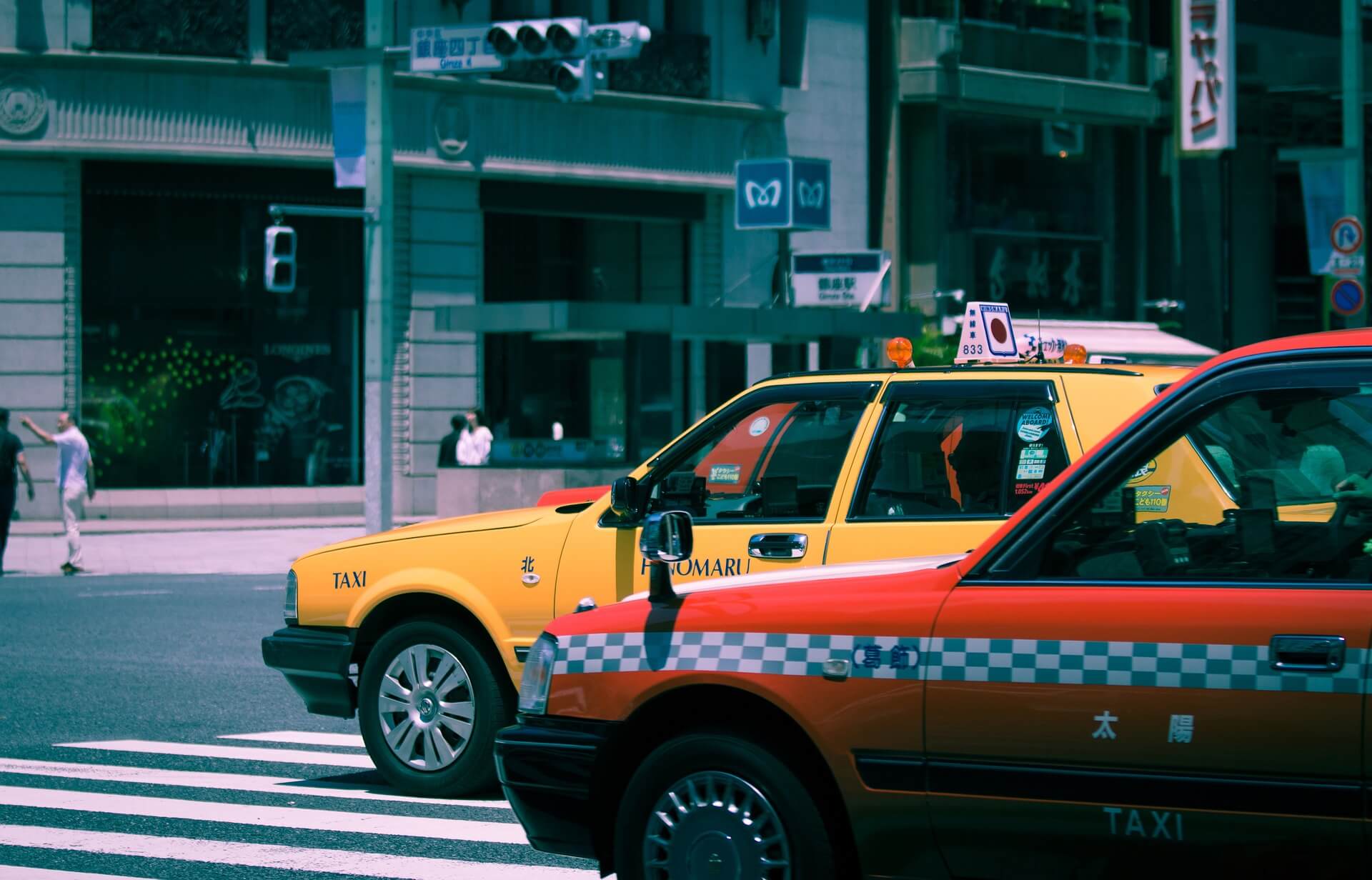
🚕 Taxis
Taxis are convenient when traveling with luggage, late at night, or when public transportation isn’t practical.
🚶 Walking
Walking is one of the best ways to explore individual neighborhoods.
Don’t underestimate distances between attractions, though. Tokyo is huge, so combining walking with trains is usually much more efficient.
💳 Using Suica
An IC card such as Suica can make transportation considerably easier.
Suica can be used on trains, subways, buses and monorails in applicable service areas, and it can also be used for electronic payments at participating stores.
For short-term foreign visitors, Welcome Suica is available without a deposit and can be used for up to 28 days.
Mobile IC options are also available on compatible smartphones.
💡 Tip: Download your preferred map and transportation apps before leaving for Tokyo so you can check routes while traveling.
🎟️ Book a Tour
Explore Mt. Fuji and Hakone on a scenic day trip featuring the Hakone Ropeway, Owakudani, and Lake Ashi. Enjoy beautiful mountain scenery and some of the region’s most memorable attractions.
Book the Tour →💵 How Much Does a Trip to Tokyo Cost?
Tokyo can be expensive, but you can also travel through the city on a relatively reasonable budget.
Your costs will depend heavily on your accommodation and dining choices.
💰 Budget Traveler
About $60–$100 per day
- 🛏️ Hostel or budget accommodation
- 🍜 Convenience stores and inexpensive restaurants
- 🚇 Public transportation
- 🆓 Free attractions and parks
- 🎟️ Limited paid attractions
💵 Mid-Range Traveler
About $100–$200 per day
- 🏨 Comfortable hotel
- 🍣 Mix of casual and mid-range restaurants
- 🚇 Public transportation
- 🎟️ Museums, observation decks and attractions
- ☕ Cafés and occasional taxis
💎 Luxury Traveler
$200+ per day
- 🏨 Upscale hotel
- 🍣 Fine dining
- 🚕 More frequent taxis
- 🎟️ Premium tours and experiences
- 🛍️ Shopping and higher-end activities
These are planning estimates rather than fixed prices. Hotel rates can vary substantially depending on the season, neighborhood, weekends, and major events.
Japan’s official tourism organization notes that accommodation in Japan ranges widely, from hostels and budget hotels to luxury properties, while dining can be relatively good value compared with many other major world capitals.
💡 Money-Saving Tip: Stay near a convenient train or subway station rather than paying a premium solely for a famous neighborhood.
👉 See our Tokyo on a Budget guide for more detailed ways to save money.
🛏️ Where to Stay in Tokyo
Tokyo is so large that choosing the right neighborhood can make a major difference.
🏙️ Best for First-Time Visitors: Shinjuku
Shinjuku is a practical base because of its huge transportation network, restaurants, shopping, and easy access to other parts of Tokyo.
💰 Best for Budget Travelers: Ueno
Ueno can offer good value while providing excellent rail connections and easy access to parks, museums, and nearby neighborhoods.
🏛️ Best for History & Culture: Asakusa
Asakusa is ideal if you want to stay surrounded by traditional architecture, temples, markets, and historic streets.
👨👩👧 Best for Families: Ueno or Tokyo Station Area
Both areas provide convenient transportation and access to attractions, shopping, museums, and restaurants.
💡 Tip: In Tokyo, being close to a convenient station can be more important than being in the “perfect” neighborhood.
🎒 Tokyo Travel Tips
Before visiting Tokyo, keep these practical tips in mind:
- 📱 Download transportation and map apps before your trip.
- 💳 Cards are widely accepted, but carrying some yen is still useful.
- 🚇 Use an IC card such as Suica or Welcome Suica for convenient transportation.
- 👟 Wear comfortable shoes because you’ll probably walk much more than expected.
- 🚉 Pay attention to station exits. Large stations can have many different exits.
- 📅 Reserve popular attractions ahead of time when required.
- ⏰ Visit major attractions early if you want a quieter experience.
- 🗣️ Learn a few Japanese phrases. Even simple greetings and thank-yous are useful.
- 🤫 Be mindful of local etiquette, particularly on trains and in temples.
- 🗑️ Don’t expect trash cans everywhere. Carry a small bag for your rubbish.
- 🚶 Avoid blocking sidewalks and station passages when stopping to check directions.
- 🚆 Don’t underestimate travel time. Tokyo’s attractions may look close together on a map but can be far apart.
👉 For more practical advice, see my Tokyo Travel Tips guide.
🎫 Best Tours & Experiences in Tokyo
Tours can be useful when you want local insight or want to experience something that is difficult to arrange yourself.
Good options include:
- 🏯 Traditional Tokyo & Asakusa Tour
- 🍣 Tokyo Food Tour
- 🚶 Tokyo Walking Tour
- 🚌 Tokyo Sightseeing Bus Tour
- 🗻 Mount Fuji Day Trip
- ⛩️ Nikko Cultural Day Trip
- 🍜 Shinjuku Food Tour
- 🗼 Tokyo Tower Admission
For travelers interested in history and culture, a guided experience around Asakusa, Nikko, or Mount Fuji can be particularly worthwhile.
🎟️ Book a Tour
Discover the natural beauty and cultural heritage of Nikko on a day trip featuring Kegon Falls, Lake Chuzenji, and Toshogu Temple.
Book the Tour →🛍️ What to Buy in Tokyo
Tokyo is a great place to shop for both modern and traditional souvenirs.
Consider bringing home:
- 🎁 Japanese souvenirs
- 🍵 Japanese tea
- 🍬 Traditional sweets
- 🎮 Anime and gaming merchandise
- 🎨 Traditional crafts
- 👘 Japanese textiles
- 🧸 Character merchandise
- 🍜 Packaged Japanese snacks
For traditional souvenirs, areas such as Asakusa are worth exploring. For modern shopping, consider Shibuya, Shinjuku, Ginza, and Harajuku.
🗺️ Best Day Trips from Tokyo
Tokyo is also an excellent base for exploring surrounding destinations.
🗻 1. Mount Fuji & Hakone
Travel time: Varies depending on destination and transportation.
Mount Fuji is one of Japan’s most iconic sights. Hakone adds hot springs, scenic landscapes, museums, and views of Mount Fuji when conditions are favorable.
⛩️ 2. Nikko
Travel time: Around 2 hours depending on the route.
Nikko is known for Toshogu Shrine, historic architecture, forests, waterfalls, and mountain scenery.
It is an excellent choice if you want to combine Japanese history with nature.
🌊 3. Kamakura
Travel time: Around 1 hour.
Kamakura is famous for temples, shrines, historic streets, and the Great Buddha.
It’s one of the easiest day trips from Tokyo and works particularly well for travelers interested in Japanese history and culture.
👉 See my Best Day Trips from Tokyo guide for more ideas.
🧳 What to Pack for Tokyo
What you need depends heavily on the season.
For most trips, consider packing:
- 👟 Comfortable walking shoes
- 👕 Weather-appropriate clothing
- ☔ Compact umbrella or rain jacket
- 🔌 Travel adapter
- 📱 Phone and charging equipment
- 💳 Credit/debit cards
- 💴 Some Japanese yen
- 🎒 Comfortable day bag
- 🧴 Personal travel essentials
- 🗺️ Offline maps or travel information
💡 Packing Tip: Prioritize comfortable shoes. A Tokyo sightseeing day can involve a surprising amount of walking, even when you’re using trains between neighborhoods.
❓ Frequently Asked Questions About Tokyo
How many days do you need in Tokyo?
Three to five days is a good starting point for most first-time visitors. Three days allows you to see many major highlights, while five days gives you more time to explore neighborhoods, museums, food, and additional attractions.
What is the best time to visit Tokyo?
Spring and autumn are generally excellent choices because of comfortable sightseeing conditions and seasonal attractions. However, Tokyo can be enjoyable throughout the year.
Is Tokyo expensive?
Tokyo can be expensive, particularly for accommodation and certain experiences, but it is possible to travel on a moderate budget. Affordable restaurants, convenience stores, public transportation, free parks, temples, and other low-cost attractions can help reduce expenses.
Is Tokyo easy to get around?
Yes. Tokyo has an extensive rail, subway, and bus network. IC cards such as Suica can make many journeys easier, while major stations and transportation systems increasingly provide multilingual information.
What food should I try in Tokyo?
Start with sushi, Tokyo-style ramen, tempura, monjayaki, yakitori, and wagashi. Tokyo also has an enormous range of regional Japanese and international cuisine.
Is Tokyo good for first-time visitors?
Yes. Tokyo is an excellent destination for first-time visitors because it combines historic temples and neighborhoods with modern attractions, excellent food, museums, shopping, and an extensive transportation network.
🌍 Final Thoughts on Visiting Tokyo
Tokyo is one of the world’s most fascinating cities because of the way its past and present exist side by side.
You can begin your morning walking through the historic streets of Asakusa, visit a peaceful shrine surrounded by trees, eat sushi or ramen for lunch, explore the colorful streets of Harajuku, and finish your day looking across the city from a skyscraper.
The best way to experience Tokyo isn’t to rush between every famous attraction. Instead, choose a few neighborhoods each day and take time to explore them.
Whether you’re interested in history, Japanese culture, architecture, food, shopping, museums, or modern city life, Tokyo offers something to discover.
🌏 Ready to explore Tokyo? Start planning your trip today!
🧭 More Tokyo Travel Guides