Tokyo can feel overwhelming at first: historic temples sit beside futuristic skyscrapers, quiet gardens appear between busy streets, and traditional markets coexist with some of the world’s most modern neighborhoods. The good news is that 3 days in Tokyo is enough to experience a strong mix of the city’s history, culture, architecture, food, and local neighborhoods without trying to see everything at once.
This itinerary is designed for a first visit and groups nearby attractions together to reduce unnecessary travel. You’ll explore traditional Asakusa and Ueno, experience the modern energy of Shibuya and Harajuku, and finish with Tokyo’s historic center around the Imperial Palace, Tokyo Station, Ginza, and Tsukiji.
The schedule uses a combination of walking, trains, and the subway. Tokyo’s extensive public transportation network makes moving between these areas relatively straightforward.
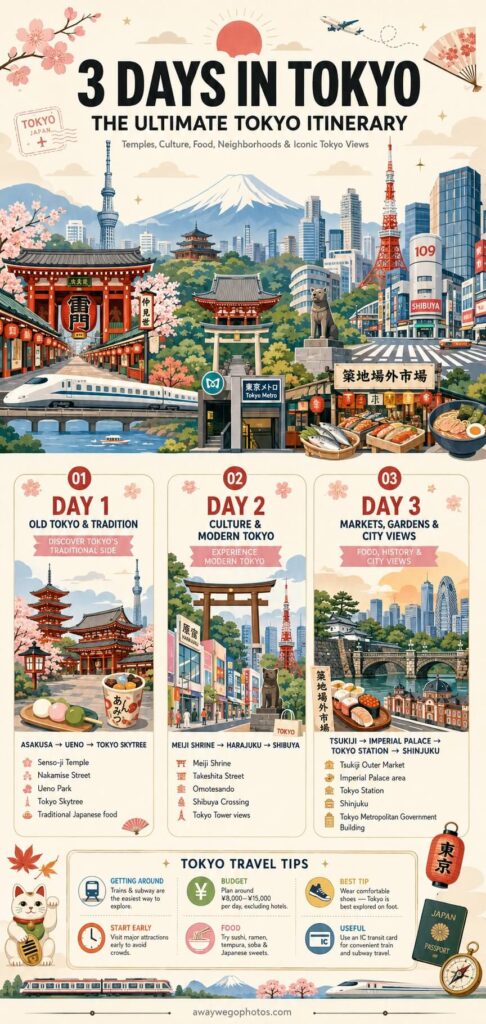
🗺️ 3-Day Tokyo Itinerary at a Glance
📍 Day 1 — Traditional Tokyo: Asakusa, Senso-ji, Sumida River, Ueno & Ameyoko
📍 Day 2 — Modern Tokyo & Culture: Meiji Jingu, Harajuku, Omotesando, Shibuya & Shinjuku
📍 Day 3 — Imperial Tokyo & Food: Tsukiji, Imperial Palace, Tokyo Station, Marunouchi & Ginza
Affiliate Disclosure:This post contains affiliate links. I may earn a small commission if you book through them, at no extra cost to you.
📍 Day 1 — Traditional Tokyo: Asakusa & Ueno
Your first day introduces the older side of Tokyo. Start in Asakusa, where one of the city’s most famous temples and traditional shopping streets provide a very different atmosphere from the skyscrapers you’ll explore later.
⛩️ Morning — Senso-ji & Asakusa
Start around 8:00–8:30 AM in Asakusa.
Begin at Kaminarimon, the Thunder Gate, the famous entrance to Senso-ji. From here, walk along Nakamise Shopping Street toward the temple.
Senso-ji is Tokyo’s oldest temple and the centerpiece of historic Asakusa. The approach through Kaminarimon and Nakamise gives you an immediate introduction to the area’s traditional character. The neighborhood is also known for crafts, souvenirs, traditional shops, and its connection to the Sumida River.
Spend roughly 1.5–2 hours exploring the temple grounds and surrounding streets.
Look for:
- 🏛️ Kaminarimon and its enormous lantern
- 🛍️ Nakamise Shopping Street
- ⛩️ Senso-ji’s main hall
- 📸 Traditional streets around the temple
- 🌿 Small gardens and quieter side streets
After visiting the temple, wander through the surrounding Asakusa streets rather than immediately moving to your next attraction. This is one of the best areas in Tokyo for experiencing the atmosphere of old downtown Tokyo.
🌊 Late Morning — Sumida River
Walk toward the Sumida River for a change of scenery.
The riverside offers views toward Tokyo Skytree and gives you a quieter break from the busy temple district. If you’re interested in architecture and city views, this is also a good place to photograph the contrast between historic Asakusa and modern Tokyo.
Allow around 30–45 minutes.
🍜 Lunch — Try a Tokyo Specialty
Return toward Asakusa for lunch.
Good choices include:
- 🍜 Soba
- 🍤 Tempura
- 🍣 Sushi
- 🍛 Japanese curry
- 🍡 Traditional sweets such as ningyo-yaki
You don’t need an elaborate restaurant reservation for lunch. One of the advantages of exploring Asakusa is the large number of casual restaurants and food shops.
🎟️ Book a Tour
Discover historic Asakusa on a guided walking tour featuring a visit to the iconic Sensoji Temple and the traditional streets surrounding this famous Tokyo neighborhood.
Book the Tour →🏛️ Afternoon — Ueno Park & Tokyo National Museum
After lunch, take the subway or train from Asakusa toward Ueno.
Ueno is one of Tokyo’s strongest areas for history, museums, parks, and traditional downtown culture. The official Tokyo travel guide describes the district as a major cultural and recreational area, with Ueno Park, museums, and the bustling Ameyoko market street.
Start with Ueno Park, then visit the Tokyo National Museum.
The museum is particularly worthwhile if you’re interested in Japanese history and culture. Its collections include Japanese art, Buddhist art, samurai swords, kabuki costumes, archaeological material, and other historical objects.
Allow approximately 2–2.5 hours for the museum.
The Tokyo National Museum currently lists general hours of 9:30 AM–5:00 PM, with later hours on certain Fridays, Saturdays, and holiday-related Sundays. It is normally closed Mondays, although schedules can change. Check the official museum website before visiting.
🛍️ Late Afternoon — Ameyoko
After the museum, walk toward Ameyoko Shopping Street.
The lively market-style street runs along the railway tracks and is a great contrast to the quiet museum grounds. Browse food shops, clothing stores, small retailers, and market stalls.
Allow around 45–60 minutes.
🌆 Evening — Ueno or Asakusa
For your first evening, keep things relaxed.
You could return to Asakusa for dinner or stay around Ueno and explore its restaurants.
A good first-night meal could include:
- 🍣 Sushi
- 🍜 Ramen
- 🍱 Japanese set meal
- 🥘 Donburi
- 🥟 Gyoza
There’s no need to make the evening about nightlife. After a full day of walking, a traditional dinner and relaxed neighborhood stroll can be a better introduction to Tokyo.
📍 Day 2 — Modern Tokyo: Meiji Jingu, Harajuku & Shibuya
Day two moves west into some of Tokyo’s most recognizable modern neighborhoods.
You’ll experience a fascinating contrast: a huge forested shrine, colorful Harajuku streets, elegant Omotesando architecture, and the enormous Shibuya crossing.
🌿 Morning — Meiji Jingu
Start around 8:00–8:30 AM at Meiji Jingu.
The walk through the forest toward the shrine is part of the experience. Meiji Jingu’s grounds cover roughly 70 hectares and contain approximately 100,000 trees donated from around Japan. The shrine is dedicated to Emperor Meiji and Empress Shoken and reflects Japan’s transformation during the late 19th and early 20th centuries.
Allow approximately 1–1.5 hours.
Meiji Jingu is open daily, but visiting hours vary by season because they are tied to daylight. Check the latest official information before your visit.
🌳 Late Morning — Yoyogi Park
Walk from Meiji Jingu toward Yoyogi Park.
This is a good place to slow down for a while. Yoyogi is one of Tokyo’s major green spaces and is popular with locals, families, couples, and people enjoying the outdoors.
You don’t need to spend hours here. Around 30–45 minutes is enough for a relaxed walk.
🍓 Lunch — Harajuku
Continue toward Harajuku for lunch.
Harajuku is famous for its youth culture, fashion, colorful streets, and kawaii culture. It also sits between Shibuya and Shinjuku on the JR Yamanote Line, making it an easy part of this day’s route.
For lunch, look for:
- 🍜 Ramen
- 🍛 Japanese curry
- 🥞 Japanese-style pancakes
- 🍣 Sushi
- 🍙 Rice-based snacks
Try not to spend the entire afternoon shopping. Tokyo has much more to offer beyond its stores.
🎟️ Book a Tour
Discover the spiritual side of Tokyo on the Meiji Jingu Shrine and Shinto Culture Walking Tour, exploring the historic shrine, its peaceful forest surroundings, and the traditions of Shinto culture.
Book the Tour →🎨 Afternoon — Omotesando & Harajuku
Walk from Harajuku toward Omotesando.
The area provides a different architectural experience from traditional Asakusa. Modern buildings, boutiques, galleries, cafes, and tree-lined streets create a more sophisticated side of Tokyo.
If you enjoy architecture, take your time looking at the buildings rather than simply using Omotesando as a shopping street.
A useful alternative is to explore some of Harajuku’s quieter side streets rather than staying only on Takeshita Street.
Allow approximately 1.5–2 hours.
📸 Late Afternoon — Shibuya
Continue south toward Shibuya.
Your first stop should be Shibuya Scramble Crossing, one of the city’s most recognizable urban scenes. The intersection outside Shibuya Station fills with pedestrians from multiple directions and has become a symbol of Tokyo’s modern energy.
Spend some time exploring the surrounding streets and viewpoints.
If you want a panoramic view, choose one observation experience rather than trying to fit several into the same day.
🍣 Evening — Dinner in Shibuya
Shibuya has an enormous range of restaurants, so this is a good opportunity to try something different from Day 1.
Consider:
- 🍣 Sushi
- 🍜 Ramen
- 🥩 Japanese beef
- 🍲 Shabu-shabu
- 🍱 Traditional set meals
If you’re still energetic, you can continue toward Shinjuku for a short evening walk. Otherwise, Shibuya is a convenient place to end the day.
📍 Day 3 — Tokyo's Historic Center: Tsukiji, Imperial Palace & Ginza
The final day combines food, history, architecture, and central Tokyo.
This route moves through Tsukiji → Imperial Palace → Tokyo Station/Marunouchi → Ginza, creating a logical east-to-west progression without repeatedly crossing the city.
🐟 Morning — Tsukiji Outer Market
Start early, around 8:00 AM.
The Tsukiji Outer Market is one of the best places to experience Tokyo’s food culture.
The famous wholesale market moved to Toyosu in 2018, but the outer market remains active. Today you’ll find hundreds of shops and restaurants selling seafood, produce, kitchenware, Japanese ingredients, and prepared foods.
This is an excellent place for breakfast.
Try:
- 🍣 Sushi
- 🥚 Tamagoyaki
- 🐟 Fresh seafood
- 🍵 Japanese tea
- 🍙 Traditional market snacks
Visit relatively early because some shops operate on individual schedules and the market is particularly active during the morning.
Allow around 1.5–2 hours.
🏯 Late Morning — Imperial Palace Area
From Tsukiji, travel toward the Imperial Palace.
The palace occupies the former site of Edo Castle and became the permanent home of Japan’s Imperial Family in 1869. The surrounding grounds combine stone walls, moats, gardens, and modern Tokyo skyscrapers.
The East Gardens are particularly worthwhile when open.
Allow approximately 1–1.5 hours for the palace area.
The goal isn’t to rush around the entire grounds. Instead, focus on the historical remnants and enjoy the contrast between Tokyo’s Edo-period past and its modern financial district.
🎟️ Book a Tour
Step into Japan’s fascinating past on the Imperial Palace and Shogun Walking Tour, exploring historic sites and learning about the shoguns who shaped Tokyo’s history.
Book the Tour →🏛️ Afternoon — Tokyo Station & Marunouchi
Walk toward Tokyo Station and the Marunouchi district.
Tokyo Station’s restored red-brick Marunouchi building is one of the city’s most recognizable architectural landmarks. The station also functions as one of Japan’s major transportation hubs, while the surrounding Marunouchi area combines historic architecture with modern skyscrapers.
Take time to photograph the station exterior before exploring the surrounding streets.
🍜 Lunch
There are plenty of restaurants around Tokyo Station and Marunouchi.
This is a good opportunity to try a different Japanese meal, such as:
- 🍜 Soba
- 🍱 Bento
- 🍛 Curry
- 🐟 Grilled fish set meal
- 🍣 Sushi
Allow around 1 hour for lunch.
🛍️ Late Afternoon — Ginza
Walk or take a short train ride toward Ginza.
Ginza is one of Tokyo’s most elegant central districts, where historic department stores and traditional businesses sit alongside modern architecture, restaurants, galleries, and luxury shopping.
You don’t have to be interested in luxury shopping to enjoy Ginza. The architecture and wide streets make it an interesting place for an afternoon walk.
Spend approximately 1.5–2 hours exploring.
📸 Evening — Final Tokyo Walk
For your final evening, stay around central Tokyo rather than making another long journey across the city.
You could:
- Walk through Ginza
- Return to Tokyo Station for evening photos
- Visit a quiet garden or plaza
- Have a final sushi dinner
- Explore the smaller streets around Yurakucho
Finish with a meal that feels distinctly Japanese rather than trying to squeeze in another major attraction.
🚇 Getting Around Tokyo
Tokyo’s public transportation system is the key to making this itinerary work.
The city has an extensive network of JR trains, Tokyo Metro lines, Toei subway lines, buses, and other rail operators. Tokyo’s subway system alone covers more than 280 stations, with multilingual signage available throughout much of the network.
For this itinerary:
Day 1: Use trains/subway between Asakusa and Ueno, then walk around each neighborhood.
Day 2: Use the train/subway to reach Harajuku and Shibuya, with substantial walking between nearby areas.
Day 3: Use the subway between Tsukiji and the Imperial Palace area, then walk between Tokyo Station, Marunouchi, and Ginza where practical.
A rechargeable IC card can make everyday travel easier. Tokyo Metro and Toei also offer 24-, 48-, and 72-hour subway tickets. The current Tokyo Subway Ticket prices listed by Tokyo Metro are ¥1,000, ¥1,500, and ¥2,000 respectively for adults. However, the pass covers Tokyo Metro and Toei Subway lines, not every train in Tokyo, so compare your planned routes before buying one.
For exact routes and current fares, use the official Tokyo Metro route planner before traveling.
🏨 Where to Stay in Tokyo
For a three-day first visit, staying near a convenient train or subway station can save significant time.
⭐ Shinjuku
A practical choice for travelers who want excellent transportation connections and easy access to western Tokyo.
Best for: First-time visitors, transportation convenience, shopping, exploring western Tokyo.
📍 Shibuya
A good choice if you want to be close to Harajuku, Meiji Jingu, Omotesando, and Shibuya itself.
Best for: Younger travelers, couples, modern Tokyo, shopping and food.
🏯 Asakusa
A more traditional-feeling option and particularly convenient for exploring eastern Tokyo.
Best for: History, culture, quieter evenings, traditional atmosphere.
🚉 Tokyo Station / Marunouchi
Excellent for travelers who want a central location and easy access to major rail connections.
Best for: Short stays, business travelers, architecture, easy transportation.
🌤️ Best Time to Visit Tokyo
Tokyo can be visited year-round, but each season offers a different experience.
🌸 Spring
Spring is famous for cherry blossoms and generally pleasant sightseeing conditions. Popular parks and viewing areas can become extremely busy during peak bloom.
☀️ Summer
Summer is hot and humid, with a higher chance of rain. Plan outdoor sightseeing for mornings and allow extra breaks during the hottest parts of the day.
🍁 Fall
Fall is one of the most comfortable seasons for walking around Tokyo. Cooler temperatures and autumn foliage make parks and gardens especially appealing.
❄️ Winter
Winter is generally cooler and can provide clearer skies. Tourist areas may feel less crowded than during peak spring periods, although holiday dates can be busy.
If seasonal events, festivals, or specific attractions are important to your trip, check the latest official Tokyo tourism information before booking.
💰 Estimated Budget for 3 Days in Tokyo
Your actual budget will vary significantly depending on accommodation, dining choices, attractions, and shopping.
As a rough planning framework per person, excluding flights and accommodation:
- 🚇 Transportation: roughly ¥1,000–¥2,000 per day for many sightseeing-focused itineraries
- 🍜 Casual meals: roughly ¥800–¥2,000 per meal
- 🏛️ Attractions: varies considerably; many shrines and outdoor areas are free, while museums and observation decks may charge admission
- 🍣 Food-focused or higher-end meals: considerably more
Treat these as planning estimates rather than fixed prices. Tokyo transportation fares and attraction admission fees can change, so verify current prices before your trip. Tokyo Metro’s current regular fares, for example, vary according to distance.
💡 3-Day Tokyo Travel Tips
- Start early. Popular areas such as Senso-ji, Meiji Jingu, and Tsukiji are much more enjoyable before the largest crowds arrive.
- Group attractions by neighborhood. Tokyo is enormous, so avoid crossing the entire city multiple times in one day.
- Wear comfortable shoes. Even with excellent public transportation, you’ll spend plenty of time walking between stations and attractions.
- Keep your itinerary flexible. Weather, crowds, restaurant queues, and attraction schedules can change your plans.
- Check museum closing days. The Tokyo National Museum, for example, normally closes Mondays, with exceptions.
- Use an IC card when practical. It can make everyday train and subway travel easier.
- Don’t overbook your evenings. Tokyo has enough daytime attractions that you don’t need a packed schedule from morning until midnight.
- Respect local customs. Be quiet on trains, follow temple and shrine etiquette, and pay attention to signs about photography.
❓ FAQ: 3 Days in Tokyo
Is 3 days enough for Tokyo?
Yes. Three days isn’t enough to see everything, but it is enough for a well-planned introduction to Tokyo. This itinerary focuses on major historic areas, cultural attractions, neighborhoods, food, and architecture without trying to cover the entire city.
What are the best areas to visit in Tokyo for first-time visitors?
Asakusa, Ueno, Harajuku, Shibuya, the Imperial Palace area, Tokyo Station, and Ginza are excellent starting points because they showcase very different sides of the city.
Should I buy a Tokyo Subway pass for 3 days?
It depends on your itinerary. Tokyo Metro currently offers a 72-hour Tokyo Subway Ticket for ¥2,000, but it only covers Tokyo Metro and Toei Subway lines. If your plans rely heavily on JR or other rail operators, an IC card may be more convenient.
What should I eat during 3 days in Tokyo?
Try to experience different types of Japanese food rather than eating the same cuisine every day. Sushi, ramen, soba, tempura, donburi, Japanese curry, and market foods such as tamagoyaki are good options.
Is Tokyo expensive to visit?
Tokyo can be expensive or relatively affordable depending on your choices. Casual restaurants and public transportation can help keep daily costs manageable, while hotels, shopping, observation decks, and high-end restaurants can increase your budget considerably.
Where should I stay for a first trip to Tokyo?
Shinjuku and Shibuya are convenient for travelers who want easy access to western Tokyo, while Asakusa offers a more traditional atmosphere. Tokyo Station and Marunouchi are excellent for transportation connections and central sightseeing.
📌 Final Thoughts
Three days in Tokyo gives you enough time to experience the city’s remarkable contrast between old and new. Start in Asakusa and Ueno for temples, museums, markets, and traditional Tokyo. Spend your second day among the forests of Meiji Jingu and the modern streets of Harajuku and Shibuya. Finish around Tsukiji, the Imperial Palace, Tokyo Station, and Ginza for a final mix of food, history, architecture, and city life.
The biggest advantage of this 3 Days in Tokyo itinerary is that each day has a different character. Rather than rushing between isolated attractions, you’ll explore Tokyo by neighborhood and experience how its history and modern identity fit together.
🧭 More Tokyo Travel Guides
- 🏆 10 Best Things to Do in Tokyo
- 🍜 10 Must-Try Foods in Tokyo
- 🗓️ 1 Day in Tokyo
- 💡 Tokyo Travel Tips
- 🗺️ Best Day Trips from Tokyo
- 📌 Tokyo Cheat Sheet
- 💵 Tokyo on a Budget