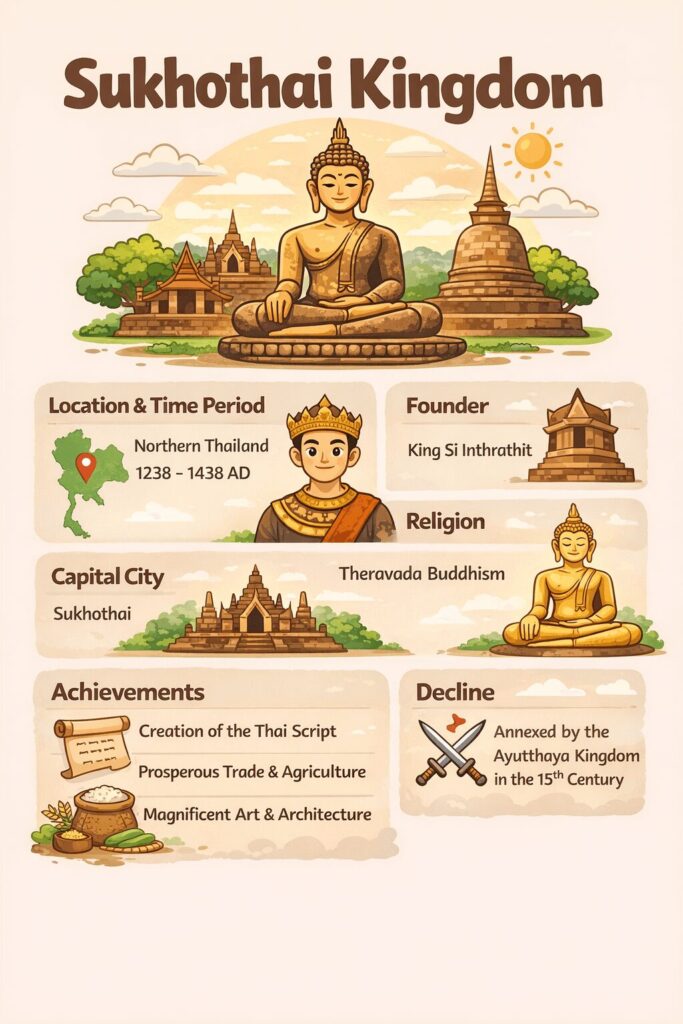
The Sukhothai Kingdom was the first major Thai kingdom and a turning point in Thailand’s history. Flourishing between the 13th and 15th centuries, it helped shape Thai culture, language, religion, and art. Its legacy continues today through historic temples, inscriptions, and the foundations of Thai civilization.
Location & Time Period
The Sukhothai Kingdom was located in what is now northern Thailand and existed from 1238 to 1438 AD. Historians often consider it the first independent Thai kingdom, marking the beginning of Thai political identity, culture, and early state development in Southeast Asia.
Founder
The kingdom was founded by King Si Inthrathit, who led a revolt against the declining Khmer Empire. After gaining independence, he established Sukhothai as a powerful Thai state and created the Phra Ruang dynasty, laying the political foundation for future Thai kingdoms.
Capital City
The capital city was Sukhothai, a name meaning “Dawn of Happiness.” The city became an important political, cultural, and religious center. It featured impressive temples, palaces, water reservoirs, and Buddha statues that reflected the kingdom’s prosperity and strong Buddhist influence.
READ MORE: 20 Fun Facts about Sukhothai Kingdom
Religion
Theravada Buddhism was the main religion of the Sukhothai Kingdom. The royal court supported monks, temples, and Buddhist learning. Religious beliefs shaped everyday life, laws, education, and art, helping Buddhism become a central element of Thai culture and identity.
Golden Age
Sukhothai reached its golden age under King Ramkhamhaeng the Great in the late 13th century. During his reign, the kingdom expanded its territory, encouraged trade with neighboring regions, and ruled with a reputation for fairness and close connection between the king and the people.
Major Achievements
One of Sukhothai’s greatest achievements was the creation of the Thai alphabet, traditionally credited to King Ramkhamhaeng. The kingdom also developed advanced irrigation systems for rice farming, expanded regional trade networks, and produced distinctive artistic styles that influenced later Thai culture.
READ MORE: Sukhothai Kingdom Timeline
Art & Architecture
Sukhothai art is famous for its elegant Buddha statues, graceful posture designs, and lotus-bud shaped stupas. Temples such as Wat Mahathat show the kingdom’s architectural brilliance. These artistic styles later influenced temple construction and sculpture throughout Thailand.
Decline
By the 15th century, Sukhothai’s power gradually declined as the rising Ayutthaya Kingdom gained influence. Eventually, Sukhothai became part of Ayutthaya’s territory. Despite its fall, the kingdom remains a vital symbol of the origins of Thai civilization, culture, and governance.
Like this Post? Save it on Pinterest!