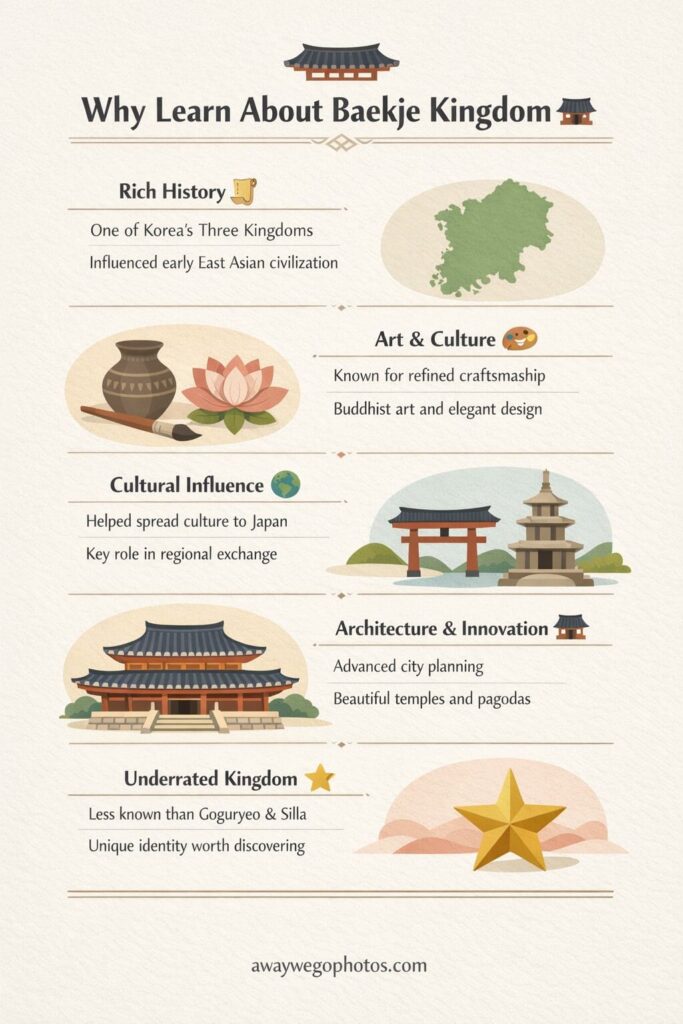
The Baekje Kingdom was one of the most influential and culturally rich civilizations in ancient Korea. As part of the Three Kingdoms era—alongside Goguryeo Kingdom and Silla Kingdom—Baekje played a vital role in shaping early Korean history, art, and international connections.
Founded in 18 BCE, Baekje grew from a small settlement near modern-day Seoul into a powerful kingdom known for its advanced culture, maritime trade, and diplomatic influence across East Asia. Its connections with Japan and China helped spread Buddhism, art styles, and technology beyond the Korean Peninsula.
Today, the legacy of Baekje lives on through historic sites, cultural traditions, and its lasting influence on neighboring regions. In this guide, you’ll explore Baekje’s history, key figures, capitals, major battles, and why it still matters today.
🏯 History of Baekje
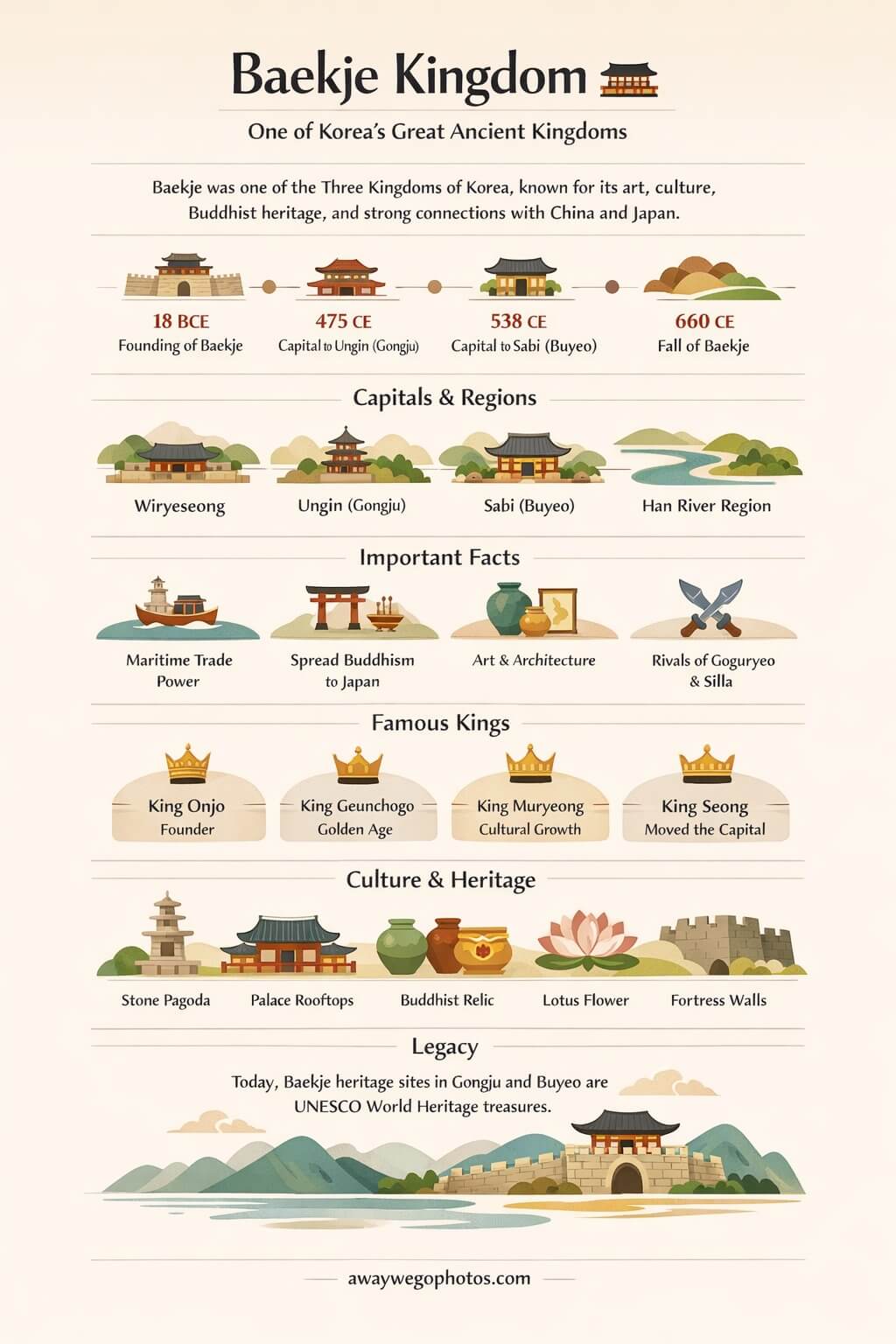
The Baekje Kingdom (18 BCE–660 CE) was one of the Three Kingdoms of Korea. Founded by Onjo of Baekje, it began near modern-day Seoul before expanding southward.
Baekje became a major maritime power known for trade and diplomacy with Japan and China.
🗺️ Key Regions (Cities) & Capitals
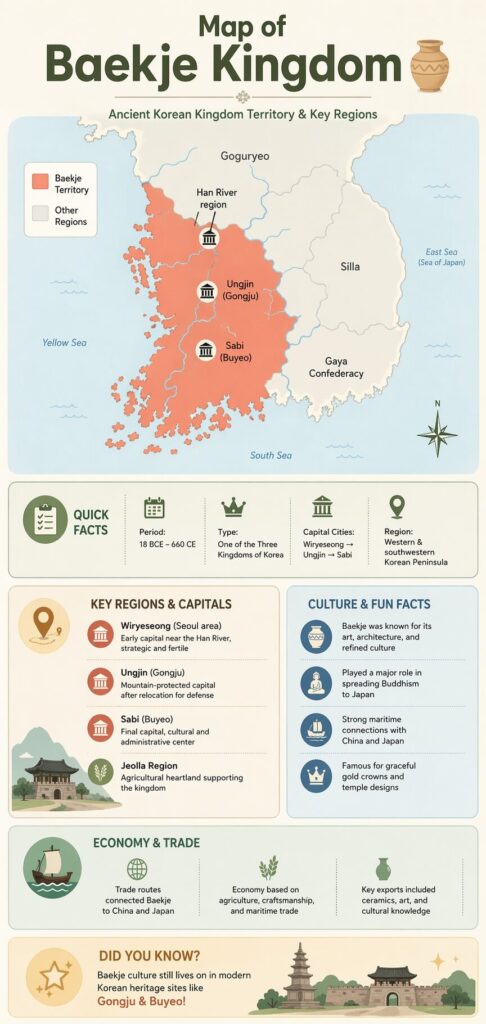
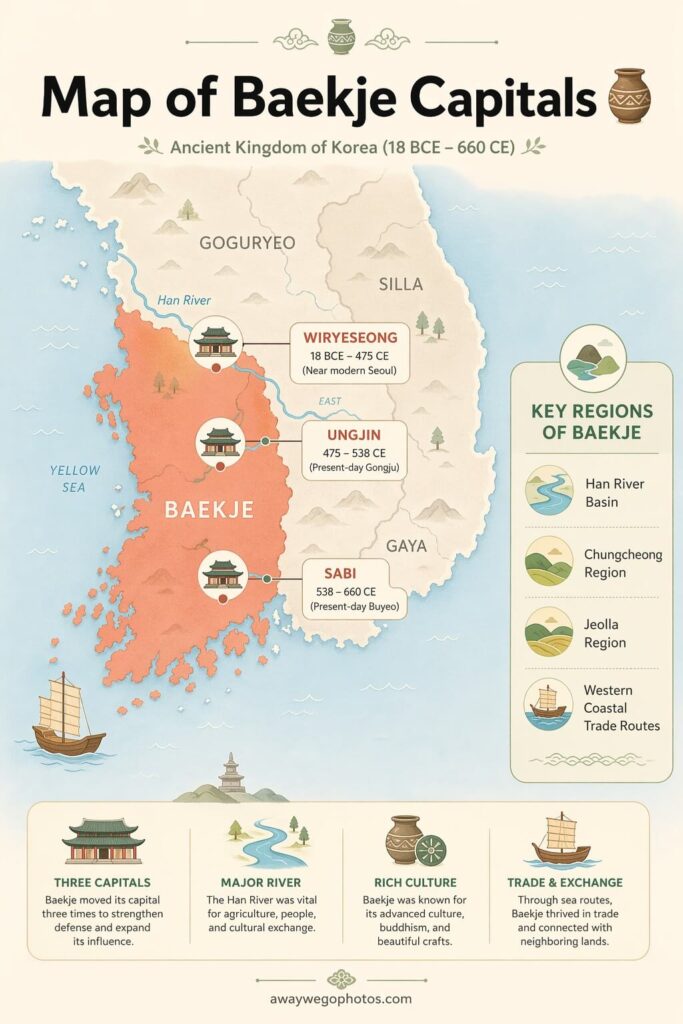
Baekje’s political center shifted over time, reflecting both strategic needs and cultural development.
🏛️ Major Capitals
Wiryeseong (위례성) – 18 BCE – 475 CE – Located near modern Seoul, this was Baekje’s first capital and early political heart.
Ungjin (웅진) – 475 CE – 538 CE – Located in present-day Gongju, chosen for its defensive geography after the fall of the northern capital.
Sabi (사비) – 538 CE – 660 CE – Located in modern Buyeo, this period marked Baekje’s cultural and administrative peak.
🌆 Key Regions & Cities
- Seoul area – Early political and economic center
- Gongju – Strategic defensive capital
- Buyeo – Cultural and royal capital
- Iksan – Secondary capital (late Baekje period, 7th century) and religious hub
- Naju region – Agricultural and regional influence zone
🇰🇷 From Seoul: 5-Day Tour of Korea with UNESCO Sites
Discover Korea’s rich history and cultural heritage on a 5-day guided tour from Seoul. Visit multiple UNESCO World Heritage sites, explore historic cities, and experience traditional culture on this immersive multi-day journey.
View Tour & Check Availability*This post may contain affiliate links. I may earn a small commission at no extra cost to you.
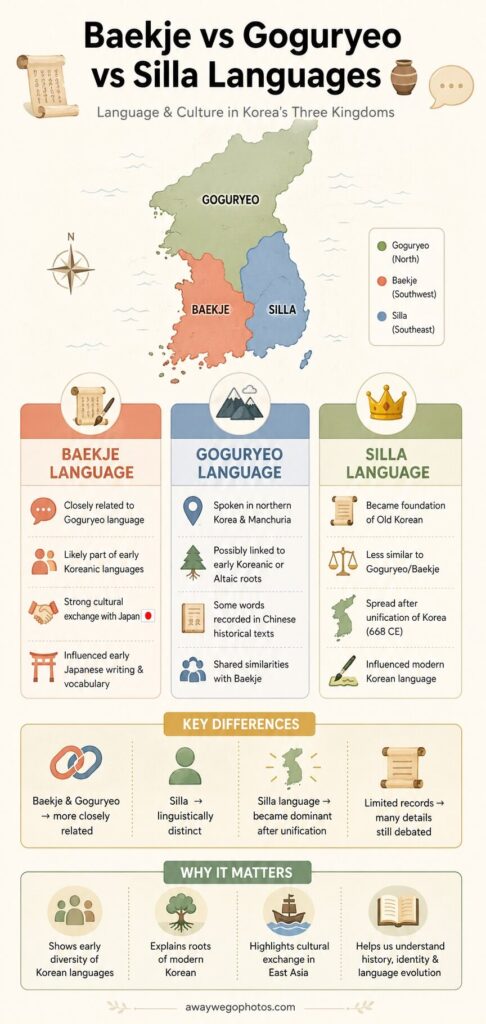
🗣️ Baekje vs Goguryeo vs Silla Language
During the Three Kingdoms period, each kingdom had its own linguistic characteristics, though none had a native writing system (they used Classical Chinese).
🏯 Baekje (백제)
- Likely spoke an early form of Korean dialects
- Shared similarities with Silla Kingdom language
- Influenced early Japanese vocabulary and writing systems
🏔️ Goguryeo (고구려)
- Possibly related to northern or Altaic language groups
- Some words preserved in Chinese historical texts
- May have influenced languages in Manchuria
👑 Silla (신라)
- Considered the closest ancestor to modern Korean
- Became dominant after unifying the peninsula
- Strong influence on Korea’s linguistic development
📝 Baekje Language
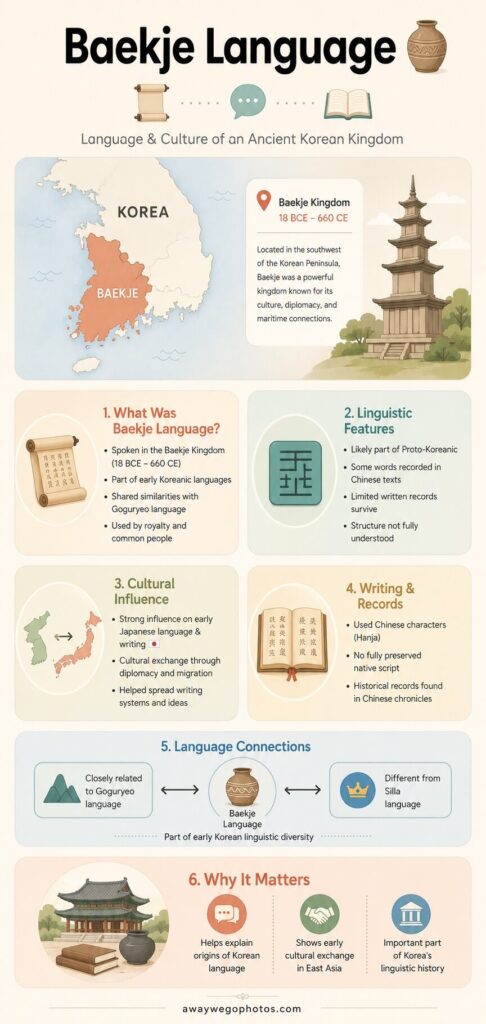
The Baekje language itself is not fully preserved, but historians believe it was closely related to early Korean dialects.
🔤 Key Characteristics
- No native writing system—used Classical Chinese for official records
- Likely part of the early Koreanic language family
- Shared vocabulary and grammar similarities with Silla
🌏 Cultural Influence
Baekje played a crucial role in transmitting language and literacy to Japan:
- Introduced Chinese characters (writing system)
- Helped spread Buddhist texts
- Influenced early Japanese court language and terminology
⚔️ Important Battle
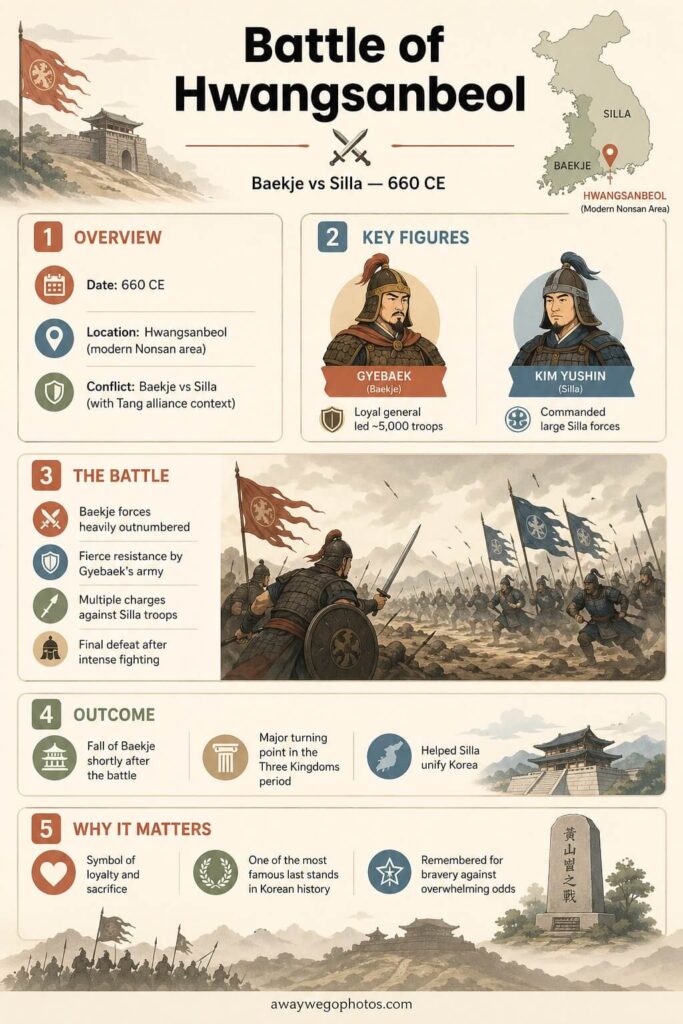
The Battle of Hwangsanbeol was the final major battle of Baekje.
- 📅 Date: 660 CE (late Three Kingdoms period)
- 📍 Location: Hwangsanbeol (modern-day Nonsan, South Korea)
- ⚔️ Main Conflict: Battle between Baekje Kingdom and Silla Kingdom
- 🧑✈️ Baekje Commander: General Gyebaek
👉 Led approximately 5,000 elite troops - 🧑✈️ Silla Commander: Kim Yu-sin
👉 Commanded around 50,000 soldiers - ⚖️ Odds: Baekje was heavily outnumbered (roughly 1:10 ratio)
- 🛡️ Famous Last Stand:
General Gyebaek is said to have killed his family before the battle to ensure total commitment from his troops - 🔥 Battle Outcome:
Decisive Silla victory after intense fighting - 🏹 Battle Highlights:
Baekje forces reportedly repelled several Silla attacks despite overwhelming odds - 🏰 Aftermath:
The defeat allowed Silla forces to advance toward Baekje’s capital, Sabi - 📉 Historical Impact:
Key turning point leading to the fall of Baekje in 660 CE - 🤝 Wider Context:
Silla fought with support from the Tang Dynasty - 🏛️ Legacy:
Remembered as a symbol of loyalty, sacrifice, and heroic resistance in Korean history
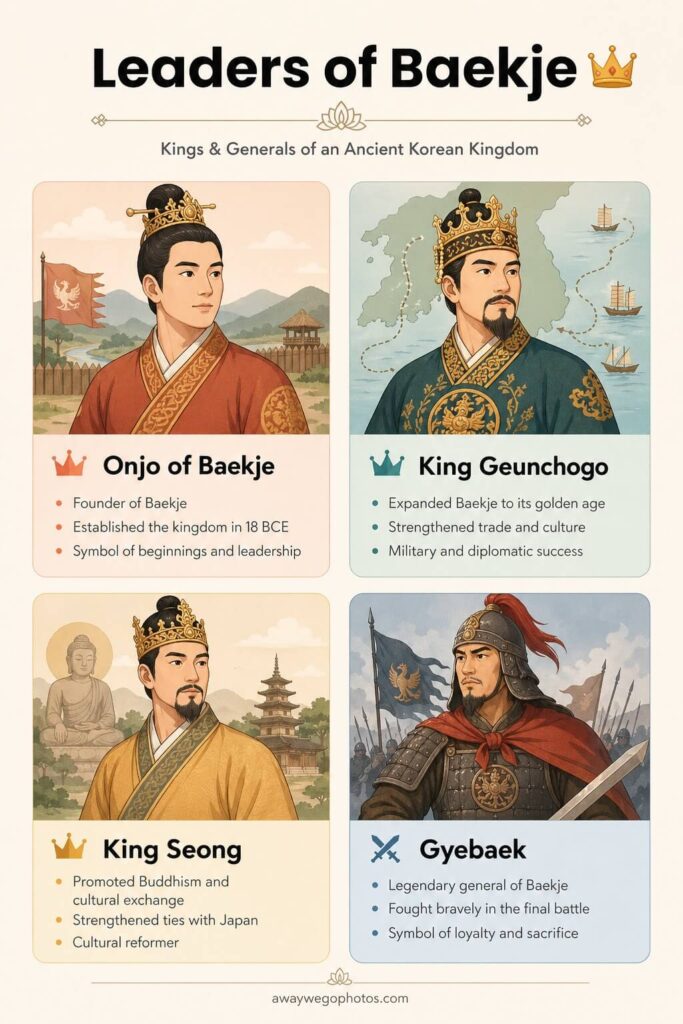
👑 Key Figures of Baekje
Onjo of Baekje
Onjo of Baekje was the founding king of Baekje and a central figure in early Korean history. His leadership, strategic decisions, and royal background helped shape one of the Three Kingdoms of Korea into a powerful and lasting state.
📌 Essential Facts
- Founder of Baekje (18 BCE)
Onjo established Baekje in 18 BCE, marking the beginning of one of Korea’s most influential ancient kingdoms. - Royal Family Background
He was the son of Jumong, the founder of Goguryeo, and So Seo-no, a key political figure who supported the rise of early kingdoms. - Migration from Goguryeo
Due to royal succession conflicts, Onjo left Goguryeo and migrated south with a group of followers to build a new kingdom. - First Capital at Wiryeseong
He established Baekje’s first capital at Wiryeseong, located in the Han River region—an area ideal for trade, agriculture, and defense. - Brother of Biryu
Onjo’s older brother, Biryu, attempted to found a separate settlement at Michuhol (modern Incheon), but it failed. Biryu’s followers later joined Onjo, strengthening Baekje. - Strong Strategic Leadership
Onjo’s choice of location and steady leadership allowed Baekje to grow quickly in both power and influence. - Early Territorial Expansion
Under his rule, Baekje expanded across central regions of the Korean Peninsula, laying the groundwork for future growth. - Long and Stable Reign
Onjo ruled for several decades (traditionally until 28 CE), providing stability during the kingdom’s early development. - Lasting Legacy
He is remembered as the founder who established Baekje’s political structure and identity, influencing Korean history for centuries.
🇰🇷 Seoul: Gyeongbok Palaces, Hanok Village, and Gwangjang Tour
Explore Seoul’s rich heritage by visiting Gyeongbokgung Palace, strolling through Bukchon Hanok Village, and tasting local favorites at Gwangjang Market. A perfect mix of history, culture, and food in one guided experience.
View Tour & Check Availability*This post may contain affiliate links. I may earn a small commission at no extra cost to you.
King Geunchogo
King Geunchogo was one of the greatest rulers of Baekje, known for expanding the kingdom’s power, strengthening its economy, and elevating its cultural influence across East Asia.
📌 Essential Facts
- 13th King of Baekje
King Geunchogo ruled Baekje during its golden age in the 4th century. - Reign (346–375 CE)
His long and stable reign allowed Baekje to reach its peak in power and influence. - Major Territorial Expansion
He expanded Baekje’s territory across much of western and southern Korea, making it a dominant regional power. - Victory Over Goguryeo
Defeated King Gogugwon of Goguryeo in 371, significantly weakening a major rival kingdom. - Control of the Han River Region
Strengthened Baekje’s hold over the Han River area, boosting trade and agriculture. - Active Trade with China and Japan
Promoted international trade and diplomacy, connecting Baekje with Chinese dynasties and early Japan. - Cultural Influence on Japan
Played a key role in spreading Chinese culture, writing systems, and Buddhism to Japan through Baekje. - Development of a Strong Central Government
Improved administrative systems, helping stabilize and organize the kingdom more effectively. - Military Strength and Organization
Built a powerful and disciplined military that supported Baekje’s expansion and defense. - Golden Age of Baekje
His reign is often considered the height of Baekje’s political, economic, and cultural achievements.
King Seong of Baekje
King Seong of Baekje was a visionary ruler of Baekje who strengthened the kingdom’s culture, promoted Buddhism, and played a key role in shaping regional diplomacy during the 6th century.
📌 Essential Facts
- 26th King of Baekje
King Seong ruled during a time of major political and cultural transformation. - Reign (523–554 CE)
His reign focused on rebuilding Baekje’s strength after earlier territorial losses. - Capital Relocation to Sabi (538 CE)
Moved the capital to Sabi (modern-day Buyeo), improving administration and strengthening royal authority. - Promotion of Buddhism
Strongly supported Buddhism as a state religion, influencing Baekje’s culture and identity. - Spread of Buddhism to Japan
Officially introduced Buddhism to Japan in 552 CE, marking a major cultural exchange between Baekje and Japan. - Government Reforms
Reorganized the administrative system, strengthening central control and governance. - Alliance with Silla
Formed a strategic alliance with Silla to counter the power of Goguryeo. - Temporary Recovery of Han River Region
Successfully reclaimed the Han River area with Silla’s help, boosting Baekje’s influence. - Betrayal by Silla
Silla later broke the alliance and took control of the Han River region, weakening Baekje. - Death in Battle (554 CE)
King Seong was killed during a military campaign against Silla, marking a turning point in Baekje’s decline.
Gyebaek
Gyebaek was a legendary military general of Baekje, remembered for his loyalty, bravery, and final stand during the kingdom’s last days.
📌 Essential Facts
- Famous Baekje General
Gyebaek served as one of Baekje’s most respected military leaders during its final years. - Loyal to Baekje Until the End
He remained devoted to Baekje even as the kingdom faced collapse. - Final Battle at Hwangsanbeol (660 CE)
Led Baekje forces against Silla during the decisive Battle of Hwangsanbeol. - Outnumbered Army
Commanded a small force (traditionally around 5,000 troops) against a much larger Silla army. - Opponent: Kim Yushin
Faced the famous Silla general Kim Yushin, one of the most skilled commanders of the time. - Legendary Last Stand
Despite being heavily outnumbered, Gyebaek fought fiercely and resisted multiple attacks. - Symbol of Loyalty and Sacrifice
His actions became a lasting symbol of loyalty, courage, and honor in Korean history. - Tragic Personal Story
According to historical accounts, he killed his own family before battle to remove any distractions and ensure total commitment. - Defeat and Death (660 CE)
Gyebaek was ultimately defeated and killed in battle, marking the fall of Baekje’s military resistance. - Enduring Legacy
Remembered as one of Baekje’s greatest heroes and a powerful symbol of unwavering dedication.
King Uija
King Uija was the final ruler of Baekje, remembered for overseeing the kingdom during its decline and ultimate fall in the 7th century.
📌 Essential Facts
- 31st and Last King of Baekje
King Uija was the final monarch, ruling during the kingdom’s last years. - Reign (641–660 CE)
His rule marked the final chapter of Baekje before its collapse. - Son of King Mu of Baekje
Inherited the throne from King Mu, continuing the royal lineage. - Early Efforts to Strengthen Baekje
Initially worked to restore order and improve governance within the kingdom. - Internal Decline and Court Corruption
Over time, Baekje faced weakening leadership, internal conflict, and political instability. - Rising Threat from Silla–Tang Alliance
Faced a powerful alliance between Silla and the Tang dynasty of China. - Fall of Sabi (660 CE)
The capital Sabi was captured by allied forces, leading to the collapse of Baekje. - Defeat by Kim Yushin and Tang Forces
Silla’s general Kim Yushin, along with Tang troops, played a key role in defeating Baekje. - Surrender and Capture
King Uija surrendered and was taken to China as a captive. - End of the Baekje Kingdom
His defeat in 660 CE marked the official fall of Baekje after centuries of history.
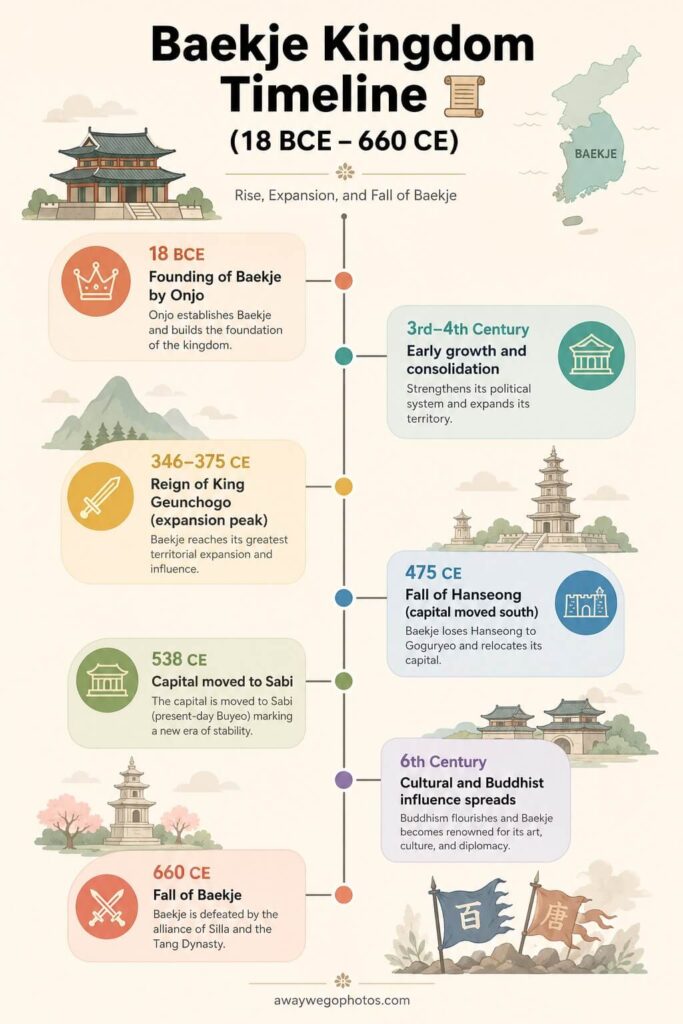
🗓️ Baekje Timeline
- 18 BCE – Baekje founded by Onjo
- 4th century – Expansion under King Geunchogo
- 475 CE – Capital moved to Ungjin
- 538 CE – Capital moved to Sabi
- 660 CE – Fall of Baekje
🎎 Language & Culture
Baekje culture was elegant and influential, blending local traditions with Chinese influences. The kingdom played a major role in transmitting Buddhism, writing systems, and artistic styles to Japan.
Baekje artisans were known for refined pottery, sculpture, and temple design, emphasizing harmony and beauty.
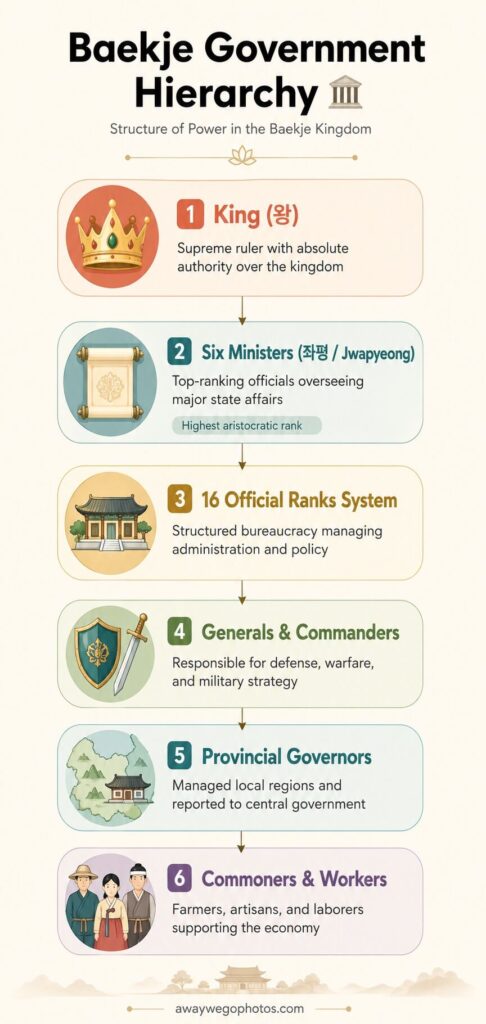
🏛️ Government & Social System
Baekje operated under a centralized monarchy with ranked officials and a structured aristocratic system. Society was divided into:
- Royal family
- Aristocrats
- Commoners
- Slaves
This system helped maintain order and administrative efficiency across the kingdom.
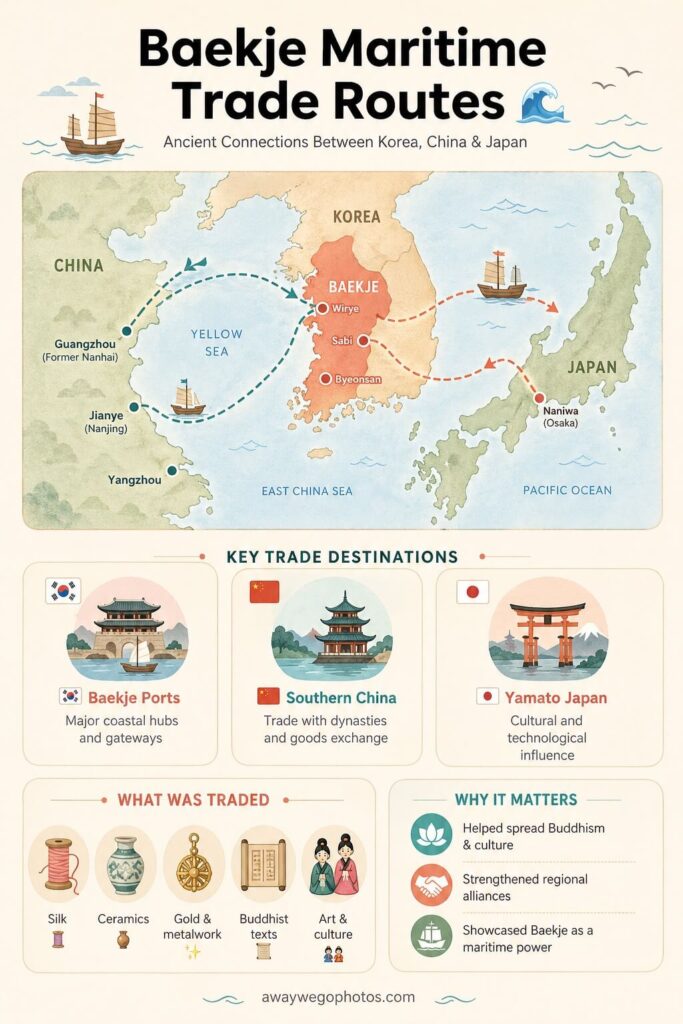
💰 Trade & Economy
Baekje’s economy relied on agriculture, craftsmanship, and maritime trade. Its coastal location made it a key hub connecting Korea with China and Japan.
Trade facilitated not only economic growth but also cultural exchange across East Asia.
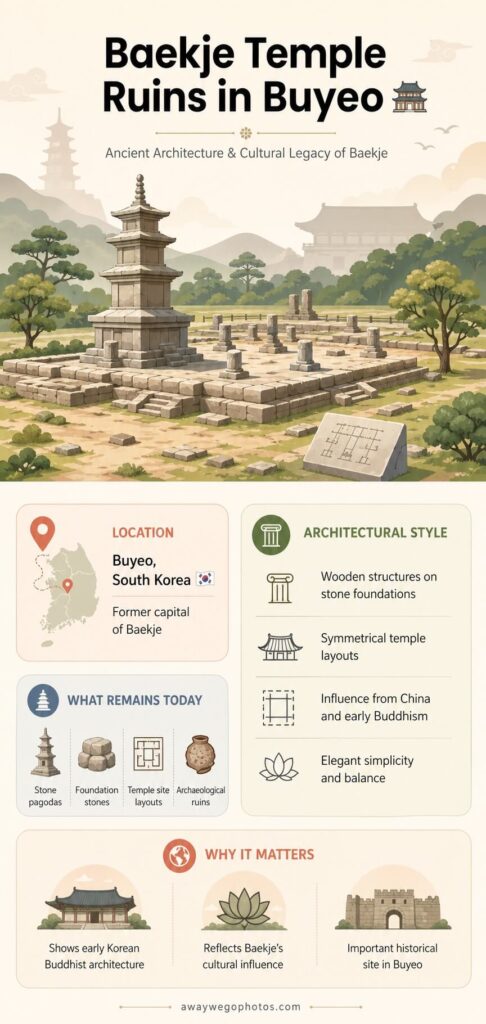
🏯 Architecture & Legacy
Baekje architecture is known for its elegance, balance, and natural harmony. Temples, pagodas, and royal tombs reflect advanced engineering and artistic sophistication.
Sites in Buyeo and Gongju are now part of UNESCO-listed Baekje Historic Areas.
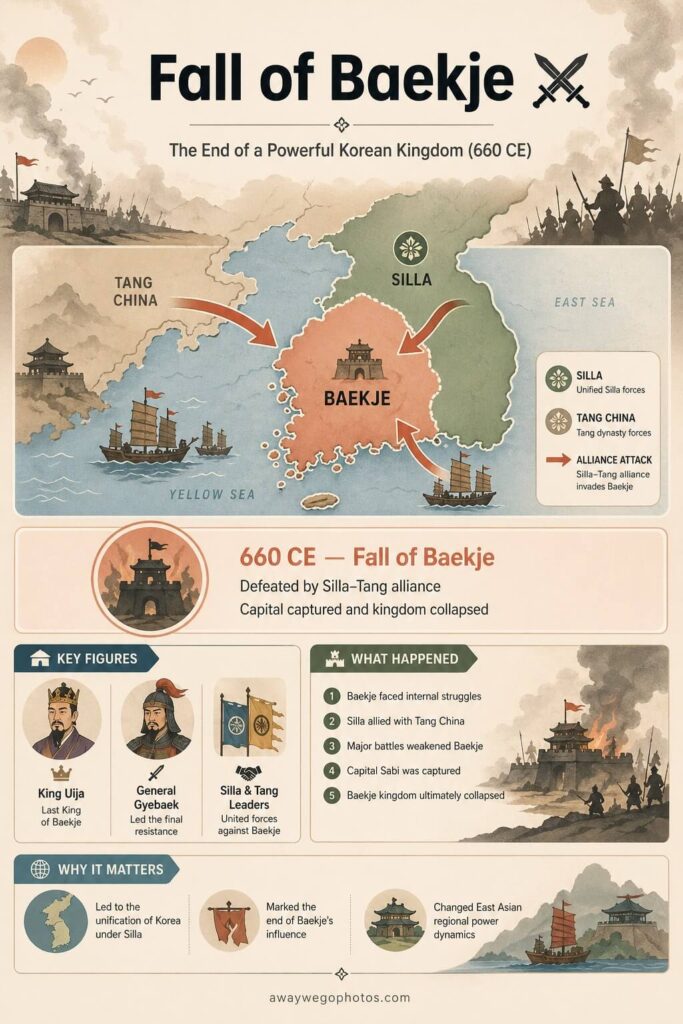
⚔️ Fall of Baekje
Baekje fell in 660 CE after defeat by the allied forces of Silla and the Tang Dynasty. Internal instability weakened the kingdom, making it vulnerable to invasion.
Efforts to revive Baekje failed, marking the end of its rule.
🌏 Why Baekje Still Matters
Baekje’s legacy continues to shape East Asian history:
- Spread of Buddhism to Japan
- Artistic and architectural influence
- Early international diplomacy
Its cultural achievements remain a key part of Korean heritage today.
✨ Thoughts
The Baekje Kingdom stands out not only for its history and capitals but also for its cultural and linguistic influence across East Asia—making it one of the most fascinating kingdoms of ancient Korea.
✈️ Plan Your Korea Trip


Like this Post? Save it on Pinterest!